 Free quote
Free quote
Free quote
Montgomery, Walker And Surrounding Counties
Tree removal, pruning, 24/7 storm work and native plantings across Montgomery, Walker and surrounding counties — Conroe to Huntsville.
Huntsville’s choice
Free quotes
What we do
Hazardous and difficult removals, including emergency work.
Structural and clearance pruning, timed so it helps the tree instead of stressing it.
24/7 emergency response after wind and flooding — hangers, leaners and blocked access.
Identifying and controlling species that crowd out natives.
Right tree, right place — planted to survive its first summers.
Selective clearing and canopy work that opens a property up without stripping it.
French drains, flood mitigation and pond expansion — where water sits and where it moves.
Pollinator patches and edible gardens built from plants native to East Texas.
Residential
Trees on a house lot are judged by the damage they could do. We assess the tree, the ground it stands in, and what is underneath it.
Leaning, decayed or storm-loosened trees taken down safely.
Structural work that keeps a tree sound instead of just smaller.
Right tree, right place, planted to survive its first summers.
Storm &
After a system moves through, the order of work matters more than the speed of it. Access first, hazards second, cleanup last.
Emergency response, access clearing and floodwater mitigation.
French drains, corrective grading and pond expansion, run off our mini track hoe.
Chinese tallow, privet and Callery pear pulled back before they take over.
Replanting with species suited to East Texas clay.
Whole property
Selectively removing what detracts from a property and highlighting the mature trees, natives and views already on it — without turning the place into a manicured subdivision.
Canopy work, selective clearing and cleanup that opens a property up without stripping it.
Overgrown understory and yaupon taken out from the roots, not just cut down.
Boundaries and property edges cleared back so they look maintained and stay accessible.
Reviews
I can’t say enough great things about this company! They were incredibly friendly, professional, and truly a breath of fresh air to work with. They safely removed a dead tree from my property and even went above and beyond by neatly stacking the wood for me to use as firewood this year. Their prices were very fair, and the quality of their work exceeded my expectations. The Arborist (billy) helped me identify every tree on my property. If you’re looking for a reliable, honest, educated and skilled tree service, I highly recommend Branching Out Arboreal and Native Plant Specialists — you won’t be disappointed!Victoria Tillman · 8 months ago
Branching Out did an amazing job removing a dangerously dead pine tree from our backyard. The tree was right next to power lines, a transformer pole, fences, and close to our home, so it was a very difficult removal with almost no room for error. The tree was so dead it was basically crumbling while they climbed it, but their crew handled everything safely and professionally without causing any damage at all. What made the job even more difficult was that another healthy tree had actually started growing out of the dead pine, and they were able to carefully remove the pine while saving the healthy tree as well. A few weeks later, another company working nearby actually dropped a tree into power lines and took down a transformer pole — which made us even more grateful we hired Branching Out. These guys clearly know what they’re doing. Highly recommend them for any tree removal or dangerous tree work.Kenzi Standley · 2 months ago
First I want to say Branching Out is a professional company. After talking to Billy he sent me a printed quote for the work we had viewed and discussed . He removed three trees for us. His price was far more reasonable than the three other verbal quotes I had received. Also the other companies came back with lower offers after their bids were rejected. The bids were still not as low as Branching Out. The job was done super well and we enjoyed working with his whole crew, including his associate Tyler who did the stump grinding.Judy Price · a month ago
They did an excellent job cutting down a tall dead pine that was in a tight spot—no one’s favorite thing to do! Great communication, friendly, professional, and courteous. We had a challenge finding someone to service our area, so we are grateful and would highly recommend.everyotherone12 · a year ago
I was trying to save a tree and most companies want to just cut them down. But Kat & Billy went over and beyond to help me save my tree. They had to cut off alot more of the rotton branches than expected. But at least I should be able to keep this tree for were hoping another 5 yrs so I have time to get another one planted and growing before I lose this one. It's my only shade tree. They were very reasonable in thier prices and very knowledgeable. Would definitely use them again and refer them out. Thanks guysKim Taylor · a year ago
Reviews from Google · read them all
Where we work
Every town below gets its own page with what the ground is actually like there.
How we work
Branching Out Arboreal & Native Plant Specialists handles tree planting, pruning and removal — including 24/7 emergency tree care — across Montgomery, Walker and the surrounding counties, from The Woodlands and Conroe up through Willis to Huntsville and beyond. What makes the work different is the second half of it: invasive species control, storm and disaster relief, drainage and flood mitigation, and sustainable landscapes built around edible gardens and pollinator patches. Most tree companies stop at the chainsaw. This one is also concerned with the water that put the tree on the ground, and with what grows back.
Call (936) 648-2843 to talk through a property.
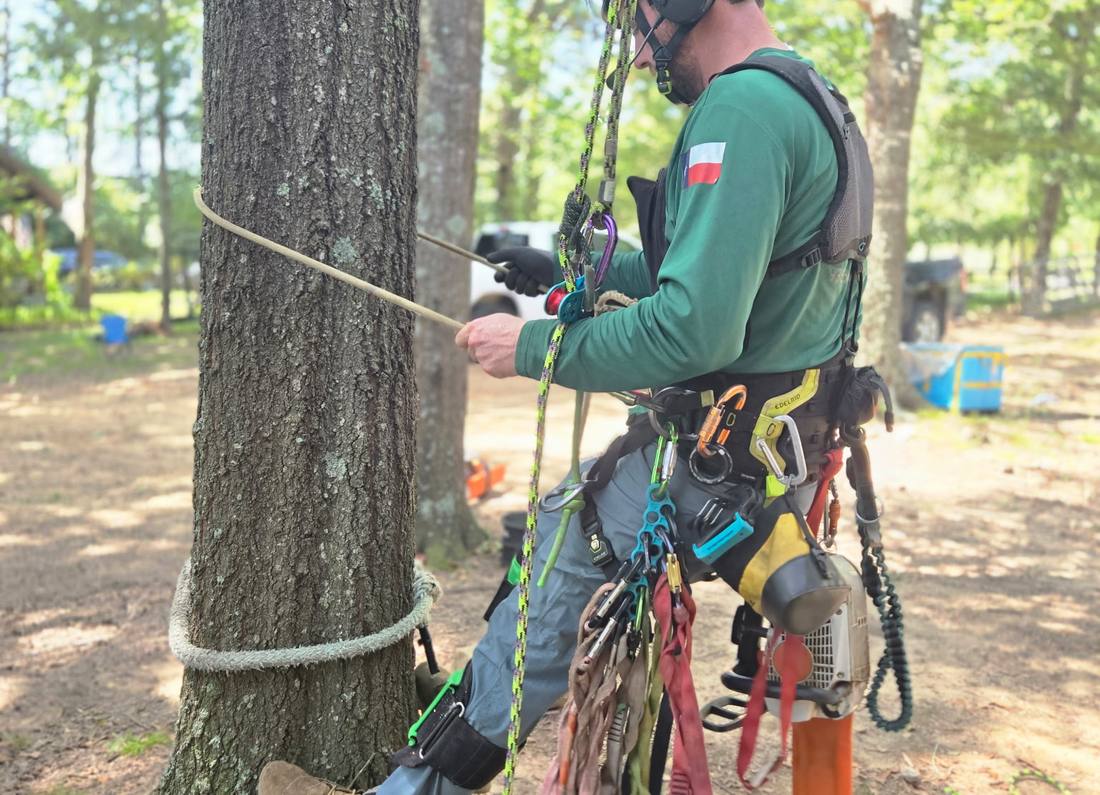
Montgomery and Walker counties sit in the Piney Woods and along the edge of the Post Oak Savannah. That means loblolly and shortleaf pine, post oak, water oak, southern red oak, sweetgum and yaupon — growing on heavy clay and clay-loam that drains slowly and holds water at the surface far longer than sand does.
Two failure patterns dominate. Pines shed limbs and lose their footing when the soil is saturated and the wind is up, which is exactly the combination a tropical system delivers this far inland. And water oaks, which grow fast and got planted everywhere for that reason, decay from the inside as they mature and start dropping large limbs long before they look sick from the ground.
Add the drought-and-flood swing this region runs on, and mature trees end up carrying stress from weather that happened years earlier. Drought-stressed pine stands are also where pine bark beetle pressure tends to show up first.
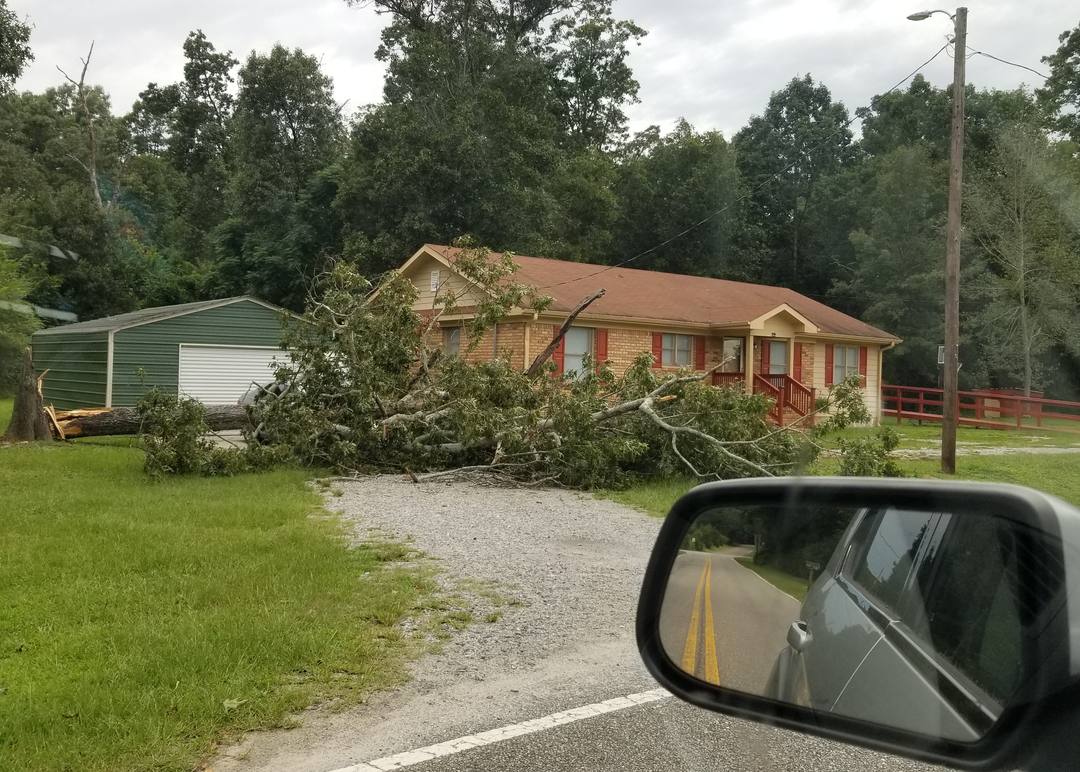
The drainage side is not a sideline bolted onto the tree work — it is the same problem seen from the other end. On clay with a perched water table, water does not soak away; it sits and it travels. That is what saturates the ground mature trees fall over in, and it is why we run a mini track hoe as well as a chipper: French drains, corrective grading and pond expansion are jobs we take on in their own right, not just cleanup after a removal.
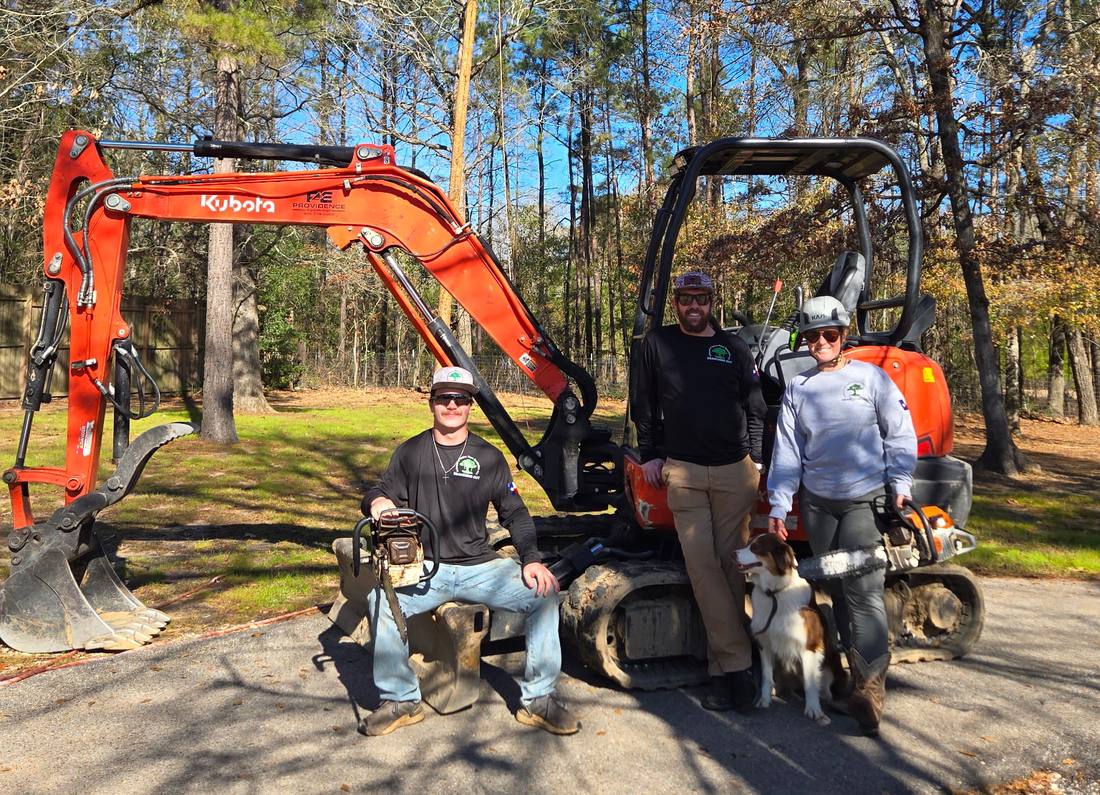
A cleared lot is not a finished job. Take out a failing water oak and you have created a gap that something will fill — and in East Texas, what fills it by default is Chinese tallow, privet or chinaberry, because those spread faster than anything native. Removal without a replant plan is how a yard slowly converts itself to invasives.
Planting back with natives — American beautyberry, Turk's cap, Texas redbud, coneflower, black-eyed Susan, milkweed for the monarch migration — puts something in that gap that holds soil, feeds pollinators, and does not need babying through a Texas August once it is established. Edible gardens and pollinator patches are the same idea aimed at food and biodiversity rather than shade alone.

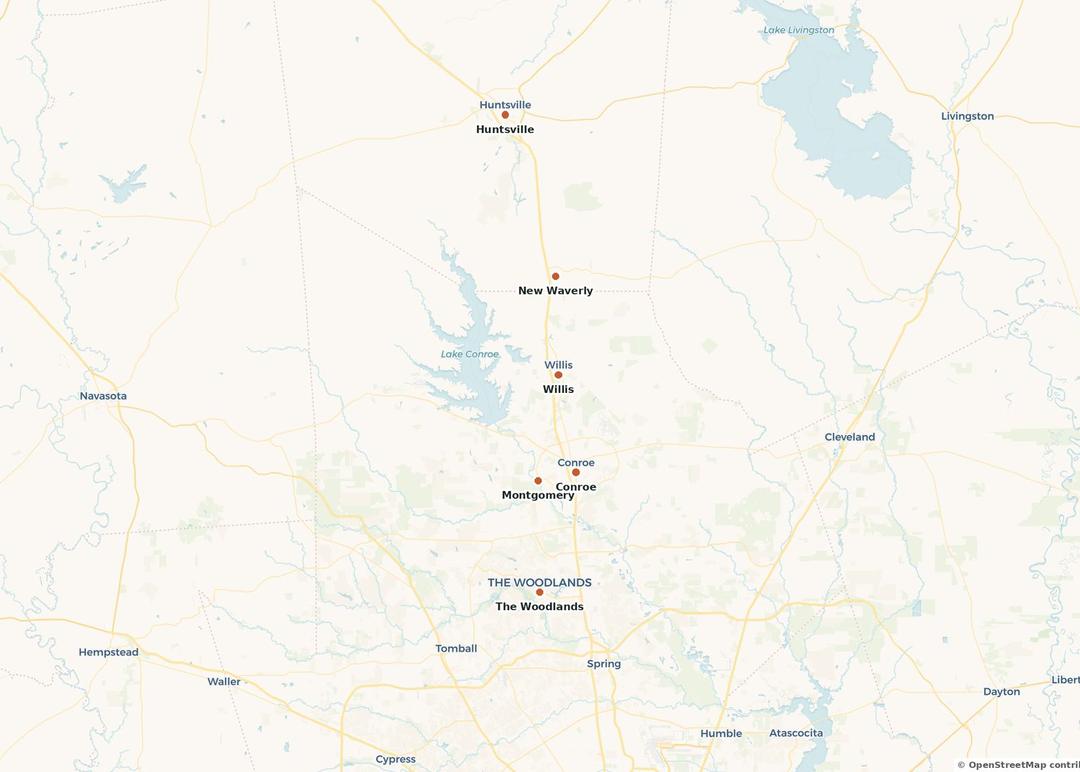
Montgomery County, Walker County, and every county that touches Walker: Grimes, Madison, Houston, Trinity and San Jacinto. Most of the work is in Huntsville, New Waverly, Conroe, Willis, Montgomery and The Woodlands. That covers the ground up both flanks of I-45 from The Woodlands to Huntsville, around Lake Conroe, out through the Sam Houston National Forest, and into the rural acreage on every side of Walker County.
Every property is different — a Woodlands lot where the tree has to come down in sections over a roof and forty acres outside New Waverly are not remotely the same job — so work is quoted per property, after someone has actually looked at the trees.
Call (936) 648-2843 or send a message through the contact page.
Why us
An agreed price in writing before anything is cut.
We tell you when a tree is worth keeping and what that takes.
Open 24/7. Storm calls are triaged ahead of scheduled work, day or night.
Habitat and native plants considered, not bulldozed.
On site
The tree, the lean, the root plate and the soil around it get looked at before a price is given.
Drive paths and drop zones planned so the lawn, beds and septic field survive the job.
Brush, rounds and debris removed. The site is left usable, not just safe.
If something is being taken out, we tell you what will hold that ground afterwards.
Getting started
Tell us the tree, the position and what is under it. Storm work gets triaged straight away.
Anything meaningful needs eyes on it. You get a written price before work is scheduled.
Access planned, ground protected, site cleared. You know what is happening and when.
Questions
Yes, 24 hours a day, 7 days a week. Storm response and floodwater mitigation are part of what we do, not a sideline. We have cut a tree off a house at 2 AM to keep that house from getting moldy. After a system moves through, the calls that matter most are the ones where a pine is leaning over a roof or a root plate has lifted in saturated ground. Those get looked at first.
No. Removal is one option among several, and often the wrong one. A tree with a structural problem in one limb usually needs that limb addressed, not the whole tree taken down. We will tell you plainly when a tree is worth keeping and what it would take to keep it.
That is where the native plant side comes in. A cleared spot is an opportunity to put something back that suits the site — a species that will handle the soil and the water table rather than one that will need replacing in six years.
Call and describe the property. Anything meaningful needs eyes on it, so we come out, look at the tree and the ground around it, and give you a written price before any work starts.
Get in touch
Call and talk to someone who does the work, or send the details and we'll get back to you.
Call (936) 648-2843