 Free quote
Free quote
Free quote
Montgomery County
Tree removal, pruning and plantings in Conroe and Montgomery County — post-construction pine decline, new subdivisions, Lake Conroe.
Conroe's defining tree problem is construction. Montgomery County has been building fast on ground that was pine forest, and the two things that happen next are predictable: the pines a builder left standing on a lot start dying three to five years after the house was finished, and the young trees planted around the new house were installed badly and are not thriving. Nearly everything else in Conroe is a variation on one of those.
Call (936) 648-2843 for tree work anywhere in the Conroe area.
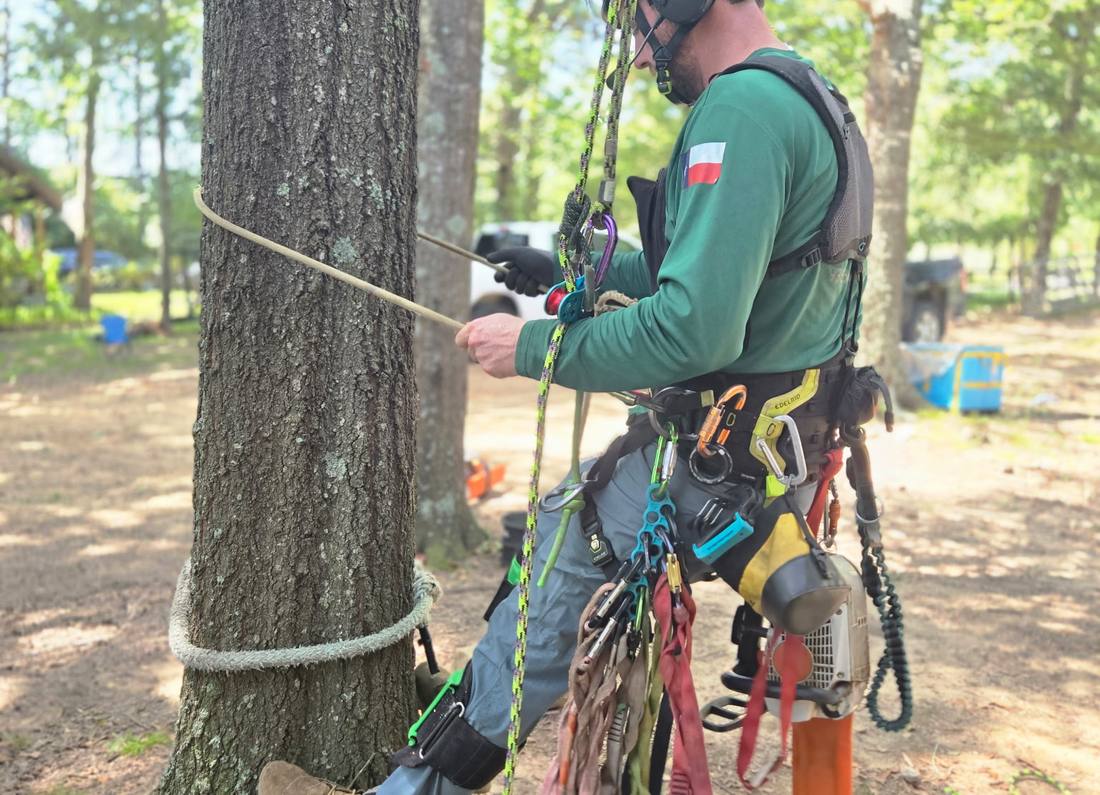
A loblolly pine's roots are shallow and spread far wider than the canopy — well past the drip line, often two or three times the crown radius. Almost all of that is in the top foot or two of soil.
Building a house on that lot means trenching for utilities, cutting a driveway, grading, and running heavy equipment across the root zone on clay. Even where the tree itself is untouched, the roots are severed on one side, compacted on another and buried under fill on a third. Compacted clay has almost no pore space left, which means the surviving roots cannot get oxygen.
The tree does not die immediately. It holds on, drawing down reserves, and then somewhere around year three to five it thins at the top, fades to a yellow-green, and pitch tubes appear on the trunk as bark beetles find a stressed host. By the time it looks bad, the decision was made years earlier by an excavator.
This is worth knowing for two reasons. If you are buying new construction, the pines on the lot are not a guaranteed asset. And if your pine is showing those symptoms now, the realistic conversation is about removing it safely rather than saving it.
The other half of Conroe work is young trees. Builder landscaping puts small trees in on a schedule, and they very often go in too deep, with circling container roots uncorrected and mulch heaped against the trunk.
Those trees are worth fixing while they are small. Pulling mulch back off the flare, correcting a girdling root, and structural pruning to establish a single strong leader are cheap now and impossible later. A subdivision oak with two competing leaders and a tight, bark-included fork will split in a windstorm around the time it is finally big enough to matter.
Then there are the Bradford pears. They were planted across Montgomery County subdivisions for years, they split apart at fifteen to twenty years old because of how they build their branch unions, and their escaped seedlings are colonizing field edges around the county. Most come out for the structural reason.
Waterfront and near-water lots have their own conditions: more wind exposure with open water on one side, wetter soil in the low spots, and often a steeper bank where root systems are doing real erosion work. Clearing a bank for a view has consequences for what holds it in the next big rain, which is where the floodwater mitigation and native planting side of this business is genuinely useful rather than decorative.
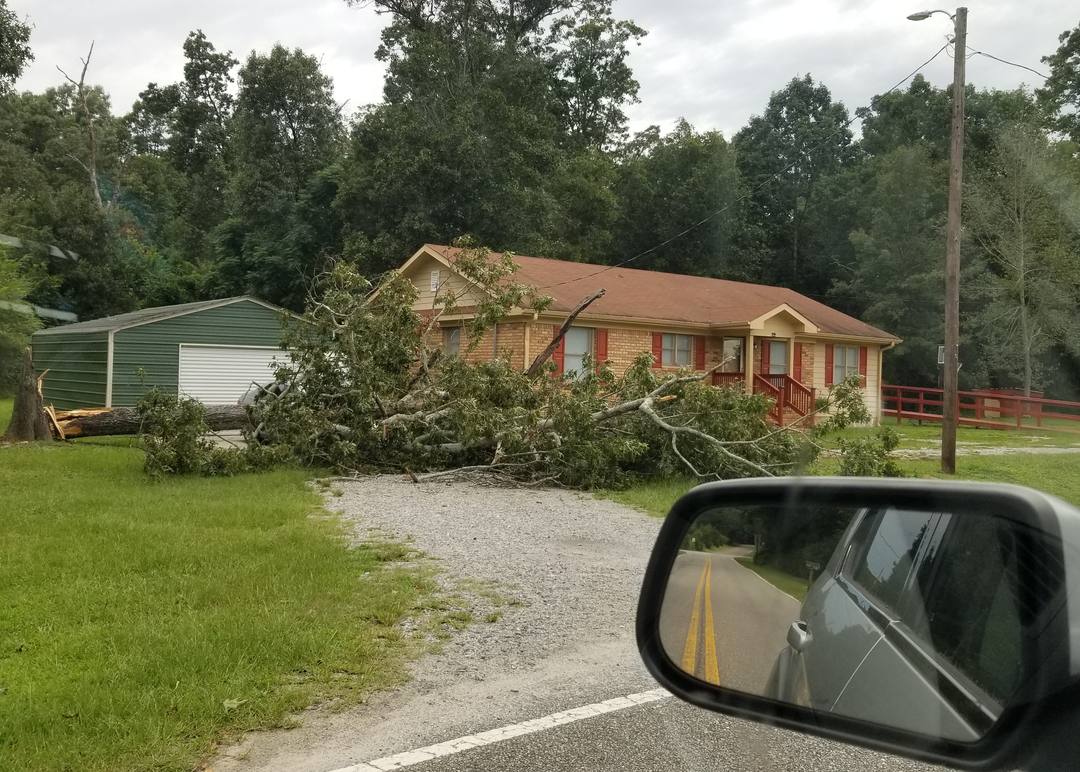
This far inland the threat is wind and prolonged saturation rather than surge. Tropical systems arrive weakened but still carry enough wind, and they deliver days of rain onto clay that cannot take it. Saturated soil is what puts pines over — the root plate loses its grip and the whole tree tips rather than breaking. Newer subdivisions with retained pines and disturbed root zones are disproportionately represented in that damage.
Services
Reviews
I can’t say enough great things about this company! They were incredibly friendly, professional, and truly a breath of fresh air to work with. They safely removed a dead tree from my property and even went above and beyond by neatly stacking the wood for me to use as firewood this year. Their prices were very fair, and the quality of their work exceeded my expectations. The Arborist (billy) helped me identify every tree on my property. If you’re looking for a reliable, honest, educated and skilled tree service, I highly recommend Branching Out Arboreal and Native Plant Specialists — you won’t be disappointed!Victoria Tillman · 8 months ago
Branching Out did an amazing job removing a dangerously dead pine tree from our backyard. The tree was right next to power lines, a transformer pole, fences, and close to our home, so it was a very difficult removal with almost no room for error. The tree was so dead it was basically crumbling while they climbed it, but their crew handled everything safely and professionally without causing any damage at all. What made the job even more difficult was that another healthy tree had actually started growing out of the dead pine, and they were able to carefully remove the pine while saving the healthy tree as well. A few weeks later, another company working nearby actually dropped a tree into power lines and took down a transformer pole — which made us even more grateful we hired Branching Out. These guys clearly know what they’re doing. Highly recommend them for any tree removal or dangerous tree work.Kenzi Standley · 2 months ago
First I want to say Branching Out is a professional company. After talking to Billy he sent me a printed quote for the work we had viewed and discussed . He removed three trees for us. His price was far more reasonable than the three other verbal quotes I had received. Also the other companies came back with lower offers after their bids were rejected. The bids were still not as low as Branching Out. The job was done super well and we enjoyed working with his whole crew, including his associate Tyler who did the stump grinding.Judy Price · a month ago
They did an excellent job cutting down a tall dead pine that was in a tight spot—no one’s favorite thing to do! Great communication, friendly, professional, and courteous. We had a challenge finding someone to service our area, so we are grateful and would highly recommend.everyotherone12 · a year ago
I was trying to save a tree and most companies want to just cut them down. But Kat & Billy went over and beyond to help me save my tree. They had to cut off alot more of the rotton branches than expected. But at least I should be able to keep this tree for were hoping another 5 yrs so I have time to get another one planted and growing before I lose this one. It's my only shade tree. They were very reasonable in thier prices and very knowledgeable. Would definitely use them again and refer them out. Thanks guysKim Taylor · a year ago
Reviews from Google · read them all
Nearby
Questions
Look at the top third of the tree. A healthy loblolly has dense dark green needles to the tip. Thinning at the crown, a dull or yellowing cast to the whole tree, needles dropping out of season, or small popcorn-like pitch tubes on the trunk all point to a stressed tree with likely bark beetle activity. Pines rarely recover from that once it is visible, and a dead pine gets harder and more expensive to remove every month it stands.
Depends on the neighborhood. Plenty of Conroe and Montgomery County subdivisions have tree provisions in the deed restrictions, sometimes requiring approval or requiring a replacement planting. Check your documents before scheduling. Where a replacement is required, that is a good opportunity to put in a species that suits the site rather than whatever the builder used.
Sometimes, if you catch it early and the damage was partial. Relieving compaction in the root zone, mulching the area properly, and watering through the stress period can carry a marginal tree through. What does not work is waiting until the crown has thinned and then trying to reverse it — at that point the root system has already been operating at a deficit for years.
Yes, and on a new-construction lot that is often the more valuable half. A cleared Conroe lot needs shade in the right places, and picking the species and the positions properly — away from the foundation, clear of the service drop, out of the septic field — is the difference between a tree that works and one that becomes a problem for the next owner.
They fit well. New subdivisions are mostly turf and a few builder shrubs, and the awkward strips — fencelines, the side yard nobody uses, the hot spot by the mailbox — convert well into native beds. Beautyberry and Turk's cap for shade, coneflower and milkweed in full sun, all of which handle Montgomery County clay better than the nursery ornamentals they replace.
Get in touch
Call and talk to someone who does the work, or send the details and we'll get back to you.
Call (936) 648-2843