 Free quote
Free quote
Free quote
Walker County
Tree removal, pruning and forest-edge work in New Waverly, TX — Sam Houston National Forest, dense pine, wooded homesites.
New Waverly is surrounded by the Sam Houston National Forest, and almost every property here is a wooded homesite rather than a landscaped yard. That means the job is usually about a stand of trees, not a specimen: which of a dozen loblolly pines around the house are actually a threat, what to do about the privet and climbing fern underneath them, and how to keep the driveway and the defensible space around the structure clear.
Call (936) 648-2843 for anything around New Waverly or south Walker County.
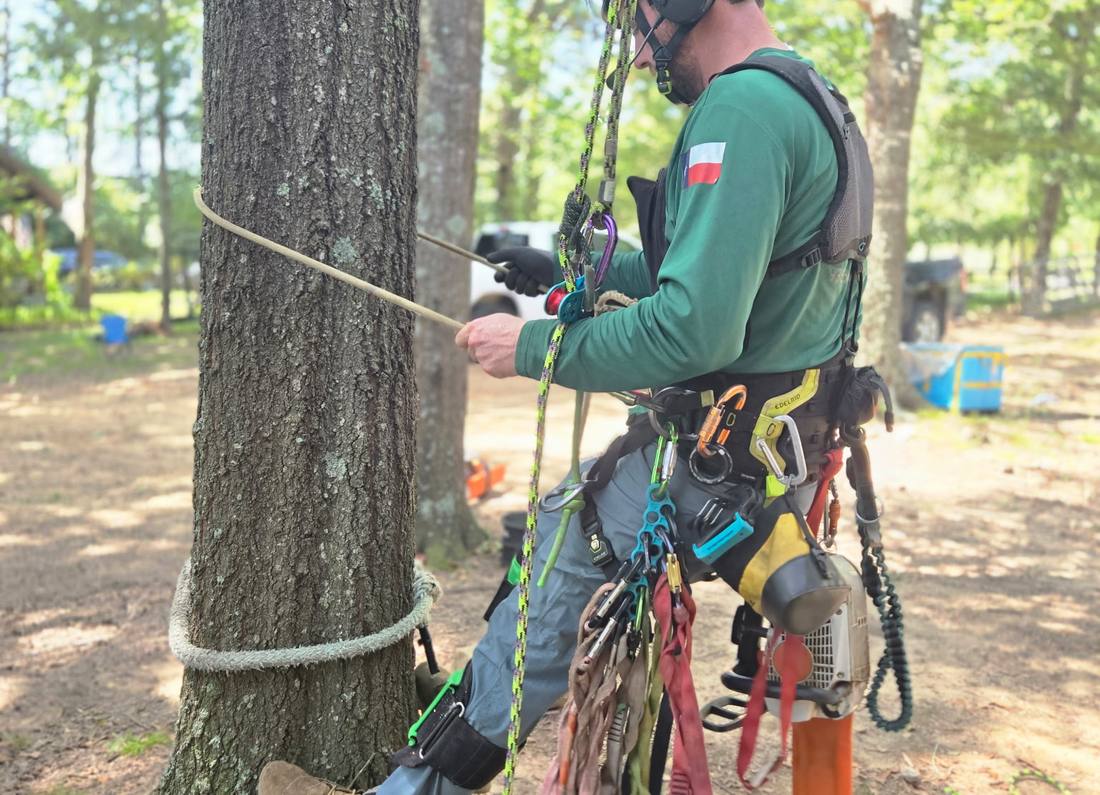
Trees grown in a closed stand compete for light by growing tall and straight rather than thick, which produces stems with poor taper, small crowns high up, and root plates that never had to hold a tree standing alone. As a group they shelter each other. Individually they are not built for exposure.
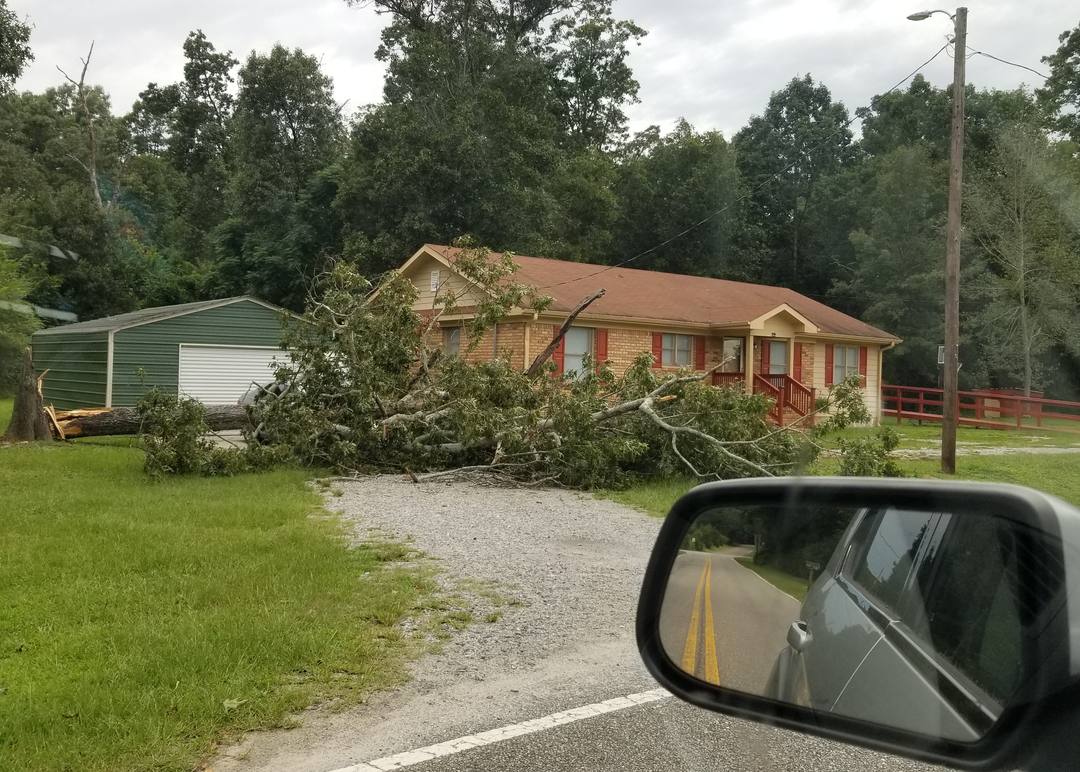
That is why gaps are dangerous. Whenever a stand opens up — a removal, a storm, a lightning-struck tree — the trees newly on the edge of that gap are the next to go, because they are suddenly taking wind load they never grew to handle.
The implication for anyone with a house tucked into pines: clearing a large area around the structure at once can make things worse before they get better. Thinning gradually, taking the genuinely defective stems first, and giving the remaining trees time to build taper is the version that ends with trees still standing.
Dense pine stands are where bark beetle pressure concentrates, because competition for water means every tree in the stand is running closer to its limit. The 2011 drought is still visible in East Texas pine, and trees that were injured then have never fully rebuilt their root systems.
The signs to watch are the same everywhere: a crown that thins from the top, a whole-tree color shift to dull yellow-green, needle drop out of season, and small pitch tubes on the trunk. Pines showing that combination rarely recover, and removing them while they are still sound enough to climb is considerably safer and cheaper than waiting until they are brittle.
Wooded lots here are full of Chinese privet under the canopy and Japanese climbing fern working up trunks and over shrubs. The privet is why nothing native is coming up under your trees. The climbing fern is the one worth taking seriously for safety reasons — it forms mats and carries fire vertically off the ground and into the canopy, which on a property that backs onto national forest is not an abstract concern.
Clearing that layer and letting native regeneration take it back — or planting beautyberry, Turk's cap and young hardwoods into it — changes the woodlot from a pine stand with bare ground into something with structure and a next generation.
Rural south Walker County properties bring practical constraints that town lots do not. Long driveways under low limbs need clearance for more than a pickup — a fire truck or a delivery vehicle needs considerably more. Septic fields and lateral lines are places you do not want equipment or large tree roots, and they are usually unmarked, so it is worth pointing out where yours runs before work starts. Well heads are the same. And gates, cattle guards and soft drives all determine what equipment can reach the work.
Living against the national forest means dry-season fire risk is real. Keeping dead material down near the structure, clearing climbing fern off trunks, keeping limbs off the roof, and maintaining a clear approach for emergency vehicles are all ordinary tree work with an extra reason behind them.
Services
Reviews
I can’t say enough great things about this company! They were incredibly friendly, professional, and truly a breath of fresh air to work with. They safely removed a dead tree from my property and even went above and beyond by neatly stacking the wood for me to use as firewood this year. Their prices were very fair, and the quality of their work exceeded my expectations. The Arborist (billy) helped me identify every tree on my property. If you’re looking for a reliable, honest, educated and skilled tree service, I highly recommend Branching Out Arboreal and Native Plant Specialists — you won’t be disappointed!Victoria Tillman · 8 months ago
Branching Out did an amazing job removing a dangerously dead pine tree from our backyard. The tree was right next to power lines, a transformer pole, fences, and close to our home, so it was a very difficult removal with almost no room for error. The tree was so dead it was basically crumbling while they climbed it, but their crew handled everything safely and professionally without causing any damage at all. What made the job even more difficult was that another healthy tree had actually started growing out of the dead pine, and they were able to carefully remove the pine while saving the healthy tree as well. A few weeks later, another company working nearby actually dropped a tree into power lines and took down a transformer pole — which made us even more grateful we hired Branching Out. These guys clearly know what they’re doing. Highly recommend them for any tree removal or dangerous tree work.Kenzi Standley · 2 months ago
First I want to say Branching Out is a professional company. After talking to Billy he sent me a printed quote for the work we had viewed and discussed . He removed three trees for us. His price was far more reasonable than the three other verbal quotes I had received. Also the other companies came back with lower offers after their bids were rejected. The bids were still not as low as Branching Out. The job was done super well and we enjoyed working with his whole crew, including his associate Tyler who did the stump grinding.Judy Price · a month ago
They did an excellent job cutting down a tall dead pine that was in a tight spot—no one’s favorite thing to do! Great communication, friendly, professional, and courteous. We had a challenge finding someone to service our area, so we are grateful and would highly recommend.everyotherone12 · a year ago
I was trying to save a tree and most companies want to just cut them down. But Kat & Billy went over and beyond to help me save my tree. They had to cut off alot more of the rotton branches than expected. But at least I should be able to keep this tree for were hoping another 5 yrs so I have time to get another one planted and growing before I lose this one. It's my only shade tree. They were very reasonable in thier prices and very knowledgeable. Would definitely use them again and refer them out. Thanks guysKim Taylor · a year ago
Reviews from Google · read them all
Nearby
Questions
Start with the ones that are already declining, then the ones with visible defects — a lean that has changed, a cracked or lifted root plate, a large dead top, an old lightning strike. After that it becomes a judgment about exposure: which stems are now on an edge, and what is under them. Walking it with someone who can see the stand as a system beats picking trees one at a time from the porch.
Some clearing, done in the right order, yes. Wholesale clearing usually is not. Removing everything close to the structure at once leaves the next ring of trees exposed to wind they never grew into, and those become the failures. Deadwood removal, roof clearance, taking the defective stems and thinning gradually gets you the safety without creating the next problem.
Yes, on the private side of the line. What is inside the Sam Houston National Forest boundary is federal ground and not something a private contractor works on — but everything on your side of it, including the edge conditions the forest creates, is fair game.
Overhanging limbs get cleared to a height that works for whatever needs to come down it, and defective trees along the lane come out. It is worth doing on a schedule rather than after a delivery truck or an emergency vehicle finds the low limb, because on a long drive the encroachment happens gradually enough that you stop noticing it.
Yes, once the privet is out. The natives that handle shade and East Texas clay — American beautyberry, Turk's cap, native ferns and woodland forbs — do well under a pine canopy, and beautyberry in particular is heavily used by birds. Where a removal has opened a genuine sunny gap, that is where a pollinator planting or an edible garden goes.
Get in touch
Call and talk to someone who does the work, or send the details and we'll get back to you.
Call (936) 648-2843