 Free quote
Free quote
Free quote
Storm & Disaster Relief
24/7 emergency tree response after wind and flooding in Walker, Montgomery and surrounding counties — leaners, hangers, trees on houses. (936) 648-2843.
After a storm, the order of operations matters more than speed. Stay away from anything touching a power line and call the utility, not a tree service. Get everyone out from under the canopy — the limb that did not fall during the storm is the one that falls the next afternoon. Then photograph everything before a single branch is moved, because that is what an insurance adjuster will ask for. Once those three things are done, call us at (936) 648-2843 and we will work out what has to happen first.
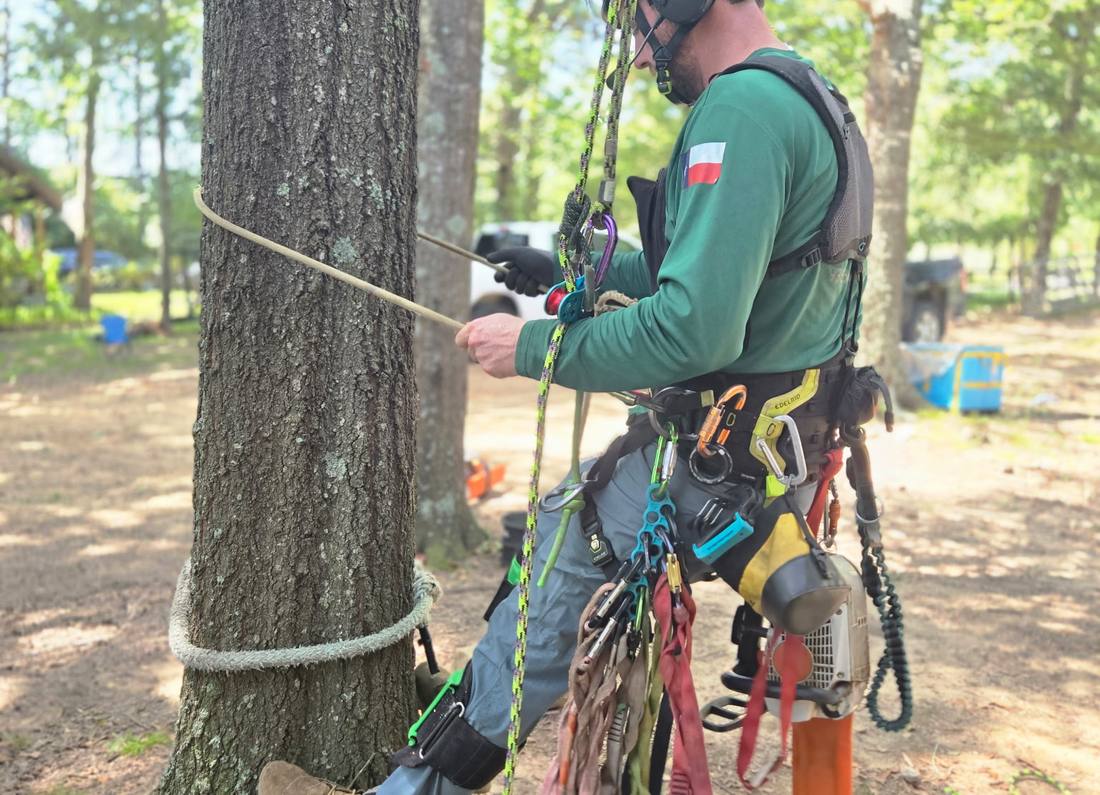
Storms do not keep business hours, and neither does this part of the job. We are emergency disaster relief, so the phone is answered day and night, seven days a week. We have cut a tree off a house at 2 AM to save it from getting moldy. A tree on a roof is not a problem that waits for Monday.
Hangers and broken limbs. A limb that has torn loose and lodged in the canopy is the most common post-storm hazard and the one people most often walk under without thinking. These come out from a rope, not from a ladder.
Leaning and uprooted trees. A tree that shifted has a partially failed root plate. It is under load, it is unstable, and cutting it in the wrong order can release that load violently. Look for cracked or heaved soil on the side opposite the lean — that is a tree that has already started to go.
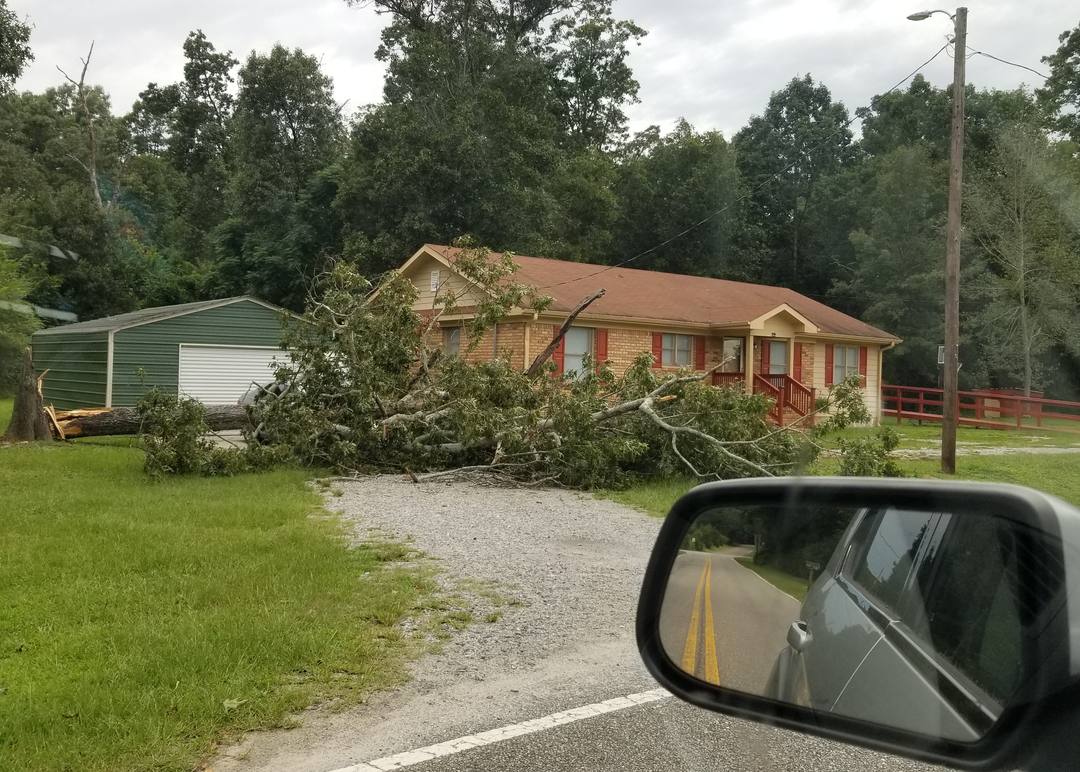
Trees down on structures. Removing weight off a roof, a fence or a vehicle requires taking the tree apart in a sequence that does not add damage on the way out.
Blocked access. Driveways, gates, farm roads and lanes cleared so you can get in and out, and so anyone else you need on the property can too.
Cleanup and hauling. Downed timber and brush processed and removed after the urgent work is done.
Walker, Montgomery and the counties around them are far enough inland that the threat is not surge. It is wind and water. Hurricanes and tropical storms that come ashore on the upper Texas coast arrive here as weakening but still substantial wind events, and they bring rain measured in days rather than hours.
That combination is specifically bad for our trees. Heavy clay and clay-loam soils hold water at the surface, and a perched water table means the ground can be saturated well below the root zone. Saturated soil loses shear strength. A loblolly pine with a wide crown and a shallow root plate, standing in ground that has taken twelve inches of rain, does not need extraordinary wind to go over — it needs ordinary wind at the wrong moment.
Hardwoods fail differently. Water oaks with internal decay break rather than tip, usually at a defect that was there before the storm. Sweetgum sheds limbs. Post oak, which is tougher and slower-grown, generally holds unless its root zone was disturbed by construction at some point.
There is also the delayed set of failures. Trees stressed by a previous drought — the 2011 drought still shows in pine stands across East Texas — carry weakened roots and dead wood for years, and a storm is when that bill comes due.
Standing water does damage that shows up months later. Roots need oxygen, and saturated soil has none; a few days is survivable for most species, weeks is not. Trees that drowned in a flood often leaf out the following spring and then decline through summer, which is why a tree that "made it through" is worth looking at again a year on.
Floodwater mitigation is part of the same conversation. Where water collects, how it moves across a property, what is holding the soil on a slope or a creek bank, and which species belong in the wet spot rather than fighting it — those are planting and grading decisions that reduce the next flood's damage instead of just cleaning up after the last one.
We do that work ourselves rather than handing you a phone number. Drainage and water management — French drains, corrective grading and pond expansion — is a service in its own right here, and the cheapest time to fix a wet corner is while the machine is already on the property for the storm work.
Storm response has taken us out of state. In Arden, North Carolina, we cleared roads and properties after a disaster — the kind of job where access comes first and everything else waits behind it.
That is worth knowing for one practical reason. Disaster work is where you find out whether a crew can rig a removal with nowhere to drop anything, sequence a site so the right hazard is dealt with first, and keep going for days without the wheels coming off. Those habits are the ones that come back to a single leaning pine over a garage in Conroe.
Included
Typical range: Quoted per property
Reviews
I can’t say enough great things about this company! They were incredibly friendly, professional, and truly a breath of fresh air to work with. They safely removed a dead tree from my property and even went above and beyond by neatly stacking the wood for me to use as firewood this year. Their prices were very fair, and the quality of their work exceeded my expectations. The Arborist (billy) helped me identify every tree on my property. If you’re looking for a reliable, honest, educated and skilled tree service, I highly recommend Branching Out Arboreal and Native Plant Specialists — you won’t be disappointed!Victoria Tillman · 8 months ago
Branching Out did an amazing job removing a dangerously dead pine tree from our backyard. The tree was right next to power lines, a transformer pole, fences, and close to our home, so it was a very difficult removal with almost no room for error. The tree was so dead it was basically crumbling while they climbed it, but their crew handled everything safely and professionally without causing any damage at all. What made the job even more difficult was that another healthy tree had actually started growing out of the dead pine, and they were able to carefully remove the pine while saving the healthy tree as well. A few weeks later, another company working nearby actually dropped a tree into power lines and took down a transformer pole — which made us even more grateful we hired Branching Out. These guys clearly know what they’re doing. Highly recommend them for any tree removal or dangerous tree work.Kenzi Standley · 2 months ago
First I want to say Branching Out is a professional company. After talking to Billy he sent me a printed quote for the work we had viewed and discussed . He removed three trees for us. His price was far more reasonable than the three other verbal quotes I had received. Also the other companies came back with lower offers after their bids were rejected. The bids were still not as low as Branching Out. The job was done super well and we enjoyed working with his whole crew, including his associate Tyler who did the stump grinding.Judy Price · a month ago
They did an excellent job cutting down a tall dead pine that was in a tight spot—no one’s favorite thing to do! Great communication, friendly, professional, and courteous. We had a challenge finding someone to service our area, so we are grateful and would highly recommend.everyotherone12 · a year ago
I was trying to save a tree and most companies want to just cut them down. But Kat & Billy went over and beyond to help me save my tree. They had to cut off alot more of the rotton branches than expected. But at least I should be able to keep this tree for were hoping another 5 yrs so I have time to get another one planted and growing before I lose this one. It's my only shade tree. They were very reasonable in thier prices and very knowledgeable. Would definitely use them again and refer them out. Thanks guysKim Taylor · a year ago
Reviews from Google · read them all
Coverage
What this job looks like in Huntsville specifically.
Questions
It depends on what happened. After an isolated storm that hit a few properties, quickly. After a regional event that takes out power across three counties, every tree company in the area is triaging, and honest sequencing means life-safety hazards and blocked access first, then trees on structures, then cleanup. We will tell you where you are in that line rather than promise a time we cannot hold.
Treat a tree that changed its lean during the storm as one. Fresh lean, cracked or mounded soil at the base, exposed roots on the opposite side, or a visible gap between trunk flare and ground all indicate the root plate has moved. Keep people and vehicles out of the fall zone in every direction — a partially uprooted tree does not necessarily finish falling the way it is currently pointing.
A tree that has leaned the same way for twenty years and shows sound, settled ground at the base is usually just a tree that grew toward the light.
That is between you and your carrier, and policies differ. What helps your case is documentation: photographs from several angles before anything is cut, of the tree, the damage and the surrounding area, plus a written scope of the work performed. We can provide a written description of what was done. We cannot tell you what your policy covers, and anyone who promises to "handle the insurance" for you is telling you something they cannot control.
Be careful. Widespread storm damage draws crews from out of the region who work fast, take deposits, and are gone before problems surface. Before anyone touches a tree, get the price in writing and know who you are dealing with. That advice costs us work sometimes and it is still the right advice.
Keep people out from under damaged canopies and away from any downed line. Tarp what is exposed to weather if you can do it safely from the ground. Take photographs. Move vehicles out of fall zones. Do not run a chainsaw on a tree that is under tension — a bent or lodged limb stores an enormous amount of energy and releases it in whatever direction it wants.
Get in touch
Call and talk to someone who does the work, or send the details and we'll get back to you.
Call (936) 648-2843