 Free quote
Free quote
Free quote
Tree Removal
Hazardous and difficult tree removal in Huntsville and Walker County — dying pines, decayed water oaks, storm leaners. Call (936) 648-2843.
A tree should come out when it is dead, when it has a structural defect it cannot recover from, or when its failure would land on something that matters — a house, a driveway, a power service, a road. Everything short of that is usually a pruning question, not a removal question. We look at the tree first and tell you which one it is, because a healthy shade tree in the Piney Woods is worth more standing than the cost of taking it down.
Call (936) 648-2843 for a look at a tree you are unsure about.
Three situations account for most removal work between Huntsville and Lake Conroe.
Mature water oaks. Water oak grows fast, tolerates wet clay, and got planted across every neighborhood in East Texas for exactly those reasons. It also decays early and thoroughly. A water oak past middle age routinely carries internal decay in the trunk and main scaffolds while the canopy still looks full from the street. The first symptom most people notice is a large limb on the lawn on a calm day. By then the tree is telling you something about the rest of its structure.
Failing loblolly and shortleaf pine. Pine is a shallow-rooted, top-heavy tree standing in clay that goes to soup after a long rain. Pines here fail two ways: they shed limbs under wind load, and they tip whole when the root plate loses its grip in saturated soil. A pine that has thinned at the top, faded to a dull yellow-green, or started pushing pitch tubes down the trunk is a beetle and stress problem that rarely turns around.
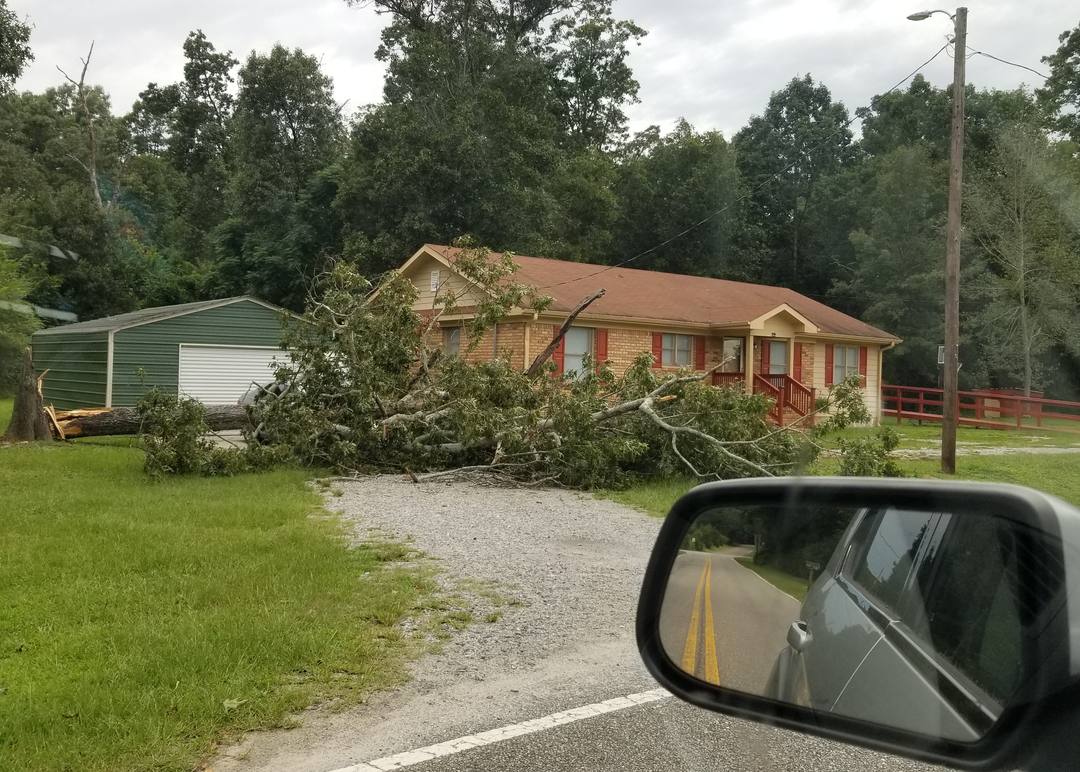
Storm-damaged leaners. A tree that moved in a storm and did not go all the way over is a different animal from a tree that has leaned since it was young. Fresh soil cracking or heaving on the uphill side of the base means the root plate has already partially failed.
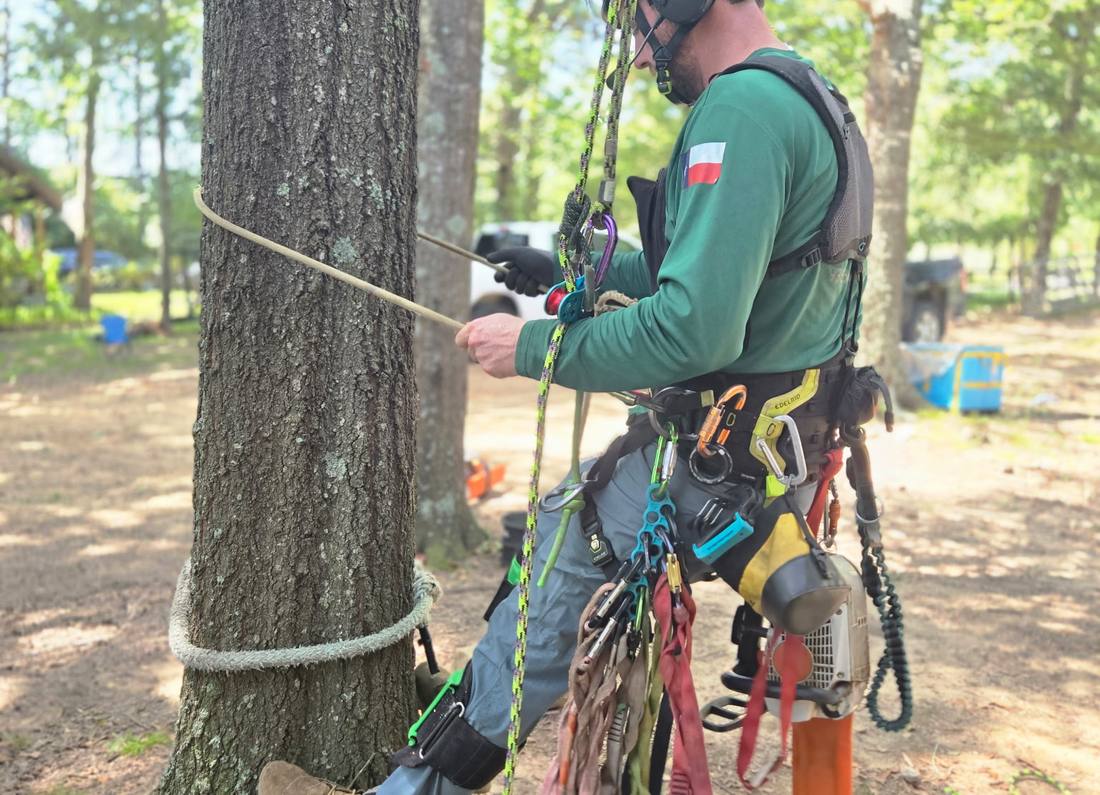
Removal on a wooded East Texas lot is mostly a rigging problem, not a felling problem. There is often nowhere to drop a 90-foot pine in one piece without hitting a roof, a fence, a septic field or a neighbor's yard, so the tree comes down in controlled sections and gets lowered rather than dropped.
That changes what matters on site: anchor points, drop zone, ground protection on soft clay, and where the truck and chipper can get to. Large removals over a target take longer than the same tree in an open pasture, and the price reflects access more than it reflects height.
Cleanup is part of the job. Brush chipped, wood cut to a size you asked for or hauled off, and the site raked out.
A removal leaves an opening — more sun, disturbed soil, and often a stump. In this region that opening does not stay empty. Chinese tallow, privet and chinaberry seed into cleared ground faster than anything native, and a year of not looking at it is enough for a thicket to establish.
If you want, we plant it back. Native replacement — Texas redbud, American beautyberry, a properly sited oak — puts something in the gap that holds the soil and does not become next decade's problem. That is a separate conversation, not an automatic upsell, but it is worth having while the equipment is already there.
Included
Typical range: Quoted per property
Reviews
I can’t say enough great things about this company! They were incredibly friendly, professional, and truly a breath of fresh air to work with. They safely removed a dead tree from my property and even went above and beyond by neatly stacking the wood for me to use as firewood this year. Their prices were very fair, and the quality of their work exceeded my expectations. The Arborist (billy) helped me identify every tree on my property. If you’re looking for a reliable, honest, educated and skilled tree service, I highly recommend Branching Out Arboreal and Native Plant Specialists — you won’t be disappointed!Victoria Tillman · 8 months ago
Branching Out did an amazing job removing a dangerously dead pine tree from our backyard. The tree was right next to power lines, a transformer pole, fences, and close to our home, so it was a very difficult removal with almost no room for error. The tree was so dead it was basically crumbling while they climbed it, but their crew handled everything safely and professionally without causing any damage at all. What made the job even more difficult was that another healthy tree had actually started growing out of the dead pine, and they were able to carefully remove the pine while saving the healthy tree as well. A few weeks later, another company working nearby actually dropped a tree into power lines and took down a transformer pole — which made us even more grateful we hired Branching Out. These guys clearly know what they’re doing. Highly recommend them for any tree removal or dangerous tree work.Kenzi Standley · 2 months ago
First I want to say Branching Out is a professional company. After talking to Billy he sent me a printed quote for the work we had viewed and discussed . He removed three trees for us. His price was far more reasonable than the three other verbal quotes I had received. Also the other companies came back with lower offers after their bids were rejected. The bids were still not as low as Branching Out. The job was done super well and we enjoyed working with his whole crew, including his associate Tyler who did the stump grinding.Judy Price · a month ago
They did an excellent job cutting down a tall dead pine that was in a tight spot—no one’s favorite thing to do! Great communication, friendly, professional, and courteous. We had a challenge finding someone to service our area, so we are grateful and would highly recommend.everyotherone12 · a year ago
I was trying to save a tree and most companies want to just cut them down. But Kat & Billy went over and beyond to help me save my tree. They had to cut off alot more of the rotton branches than expected. But at least I should be able to keep this tree for were hoping another 5 yrs so I have time to get another one planted and growing before I lose this one. It's my only shade tree. They were very reasonable in thier prices and very knowledgeable. Would definitely use them again and refer them out. Thanks guysKim Taylor · a year ago
Reviews from Google · read them all
Coverage
What this job looks like in Huntsville specifically.
What this job looks like in Conroe specifically.
What this job looks like in The Woodlands specifically.
Questions
Often it can be saved. Deadwood, a single failed limb, storm-torn branches or a crowded canopy are pruning work. Removal is the answer when the trunk or the root plate is compromised, when a large share of the canopy is already dead, or when the tree is structurally sound but standing somewhere it cannot safely stay. We will say so either way — there is no reason to remove a tree that has another thirty years in it.
Take it out sooner rather than later. A dead pine loses limbs first, then bark, then structural integrity in the trunk, and every one of those stages makes the removal more difficult and more expensive to do safely. Dead pines also become brittle enough that they cannot be climbed, which means the job needs equipment that the same tree would not have needed six months earlier.
On private residential property in this part of Texas, removal is generally the owner's call, but rules vary by city, by subdivision and by whether the tree is in a right-of-way or an easement. HOA-governed neighborhoods around Conroe, Montgomery and Willis often have their own tree provisions in the deed restrictions. Check your HOA documents, and check with the city if the tree is near the street. We will tell you when a tree looks like it sits in a right-of-way.
Your choice. Brush goes through the chipper; chips can stay on site as mulch — which is genuinely useful on clay — or leave with us. Trunk wood can be bucked to firewood length and stacked, or hauled off. Hauling everything away costs more than leaving usable wood behind, so it is worth deciding before the quote.
Clay soil after rain is the risk, and it is a real one. Heavy equipment on saturated ground leaves ruts that do not settle out on their own. We work off plywood or mats where it matters, stage from the driveway when we can, and on genuinely soggy ground the right answer is sometimes to wait a few days rather than repair a lawn afterward.
Stump grinding is quoted separately because not everyone wants it. Left alone, a hardwood stump in this climate takes years to break down and many species will send up suckers around it in the meantime. Ground out, you get a hole full of chips that needs soil and something planted in it — which is a good moment to put a native back.
Get in touch
Call and talk to someone who does the work, or send the details and we'll get back to you.
Call (936) 648-2843