 Free quote
Free quote
Free quote
Montgomery County
Tree care in Montgomery, TX — legacy oaks, wooded acreage west of Lake Conroe, HOA neighborhoods and native plantings. (936) 648-2843.
Montgomery has better trees than most of the county, and the work here is largely about keeping them. This is one of the older towns in the region, west of Lake Conroe, with a historic center, big legacy hardwoods along the older streets, and wooded acreage and golf-course communities spreading out around it. Preservation work — deadwood, structural pruning, root zone protection — makes up more of the job here than removal does.
Call (936) 648-2843 for anything in Montgomery or the surrounding area.
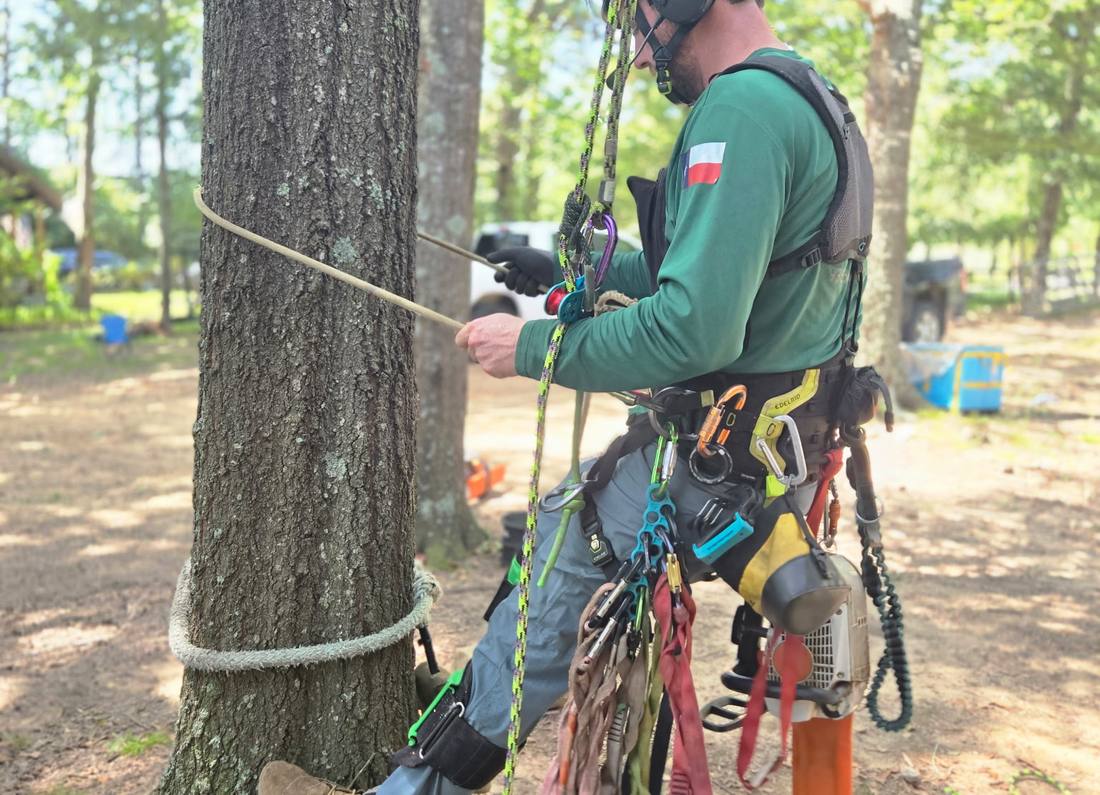
The large old oaks around the historic part of town are the kind of tree that cannot be replaced in a working lifetime. They also tend to die from causes that had nothing to do with the tree's health: a driveway poured over the root zone, a utility trench cut through one side of it, fill dirt spread to level a yard, or equipment parked on the roots through a construction project.
Post oak in particular is unforgiving about that. It is a tough, slow, long-lived native that handles heat and poor soil, and it responds very badly to root disturbance and to changes in grade. A post oak that has been fine for a hundred years can decline and die within a few seasons of a driveway going in.
The useful work on these trees is unglamorous: keeping the root zone mulched rather than mowed, keeping traffic and fill off it, removing deadwood, and doing structural work in the right season. Oaks specifically should not be pruned in the spring window when oak wilt spreads most readily — generally February through June — and when a genuine hazard forces the issue, the cuts get sealed immediately.
Plenty of Montgomery-area property is wooded lot or small acreage, some of it in communities where the trees were the reason the neighborhood exists. The recurring problem is the understory: Chinese privet forms a solid layer under the canopy and stops anything native from regenerating, so the woods have big trees, bare ground, and nothing coming up in between.
That matters practically, not just ecologically. A woodlot with no young trees coming has a canopy with an expiry date. Clearing the privet and letting native regeneration — or a deliberate planting of beautyberry, Turk's cap and young hardwoods — take that layer back is what keeps it a woods rather than a stand.
Japanese climbing fern shows up on trunks in the same properties, and it carries fire vertically, which is a specific reason to take it seriously rather than treat it as a nuisance vine.
A fair amount of Montgomery County housing sits under deed restrictions or an HOA, and several of the communities here are gated. Two practical consequences.
First, removals and sometimes significant pruning may need approval, and some restrictions require a replacement planting. Worth reading your documents before scheduling, and worth planning the replacement as a real decision rather than whatever is cheapest at the nursery.
Second, access has to be arranged in advance — gate codes, contractor registration, restricted work hours. That is straightforward as long as it happens before the truck arrives rather than at the gate.
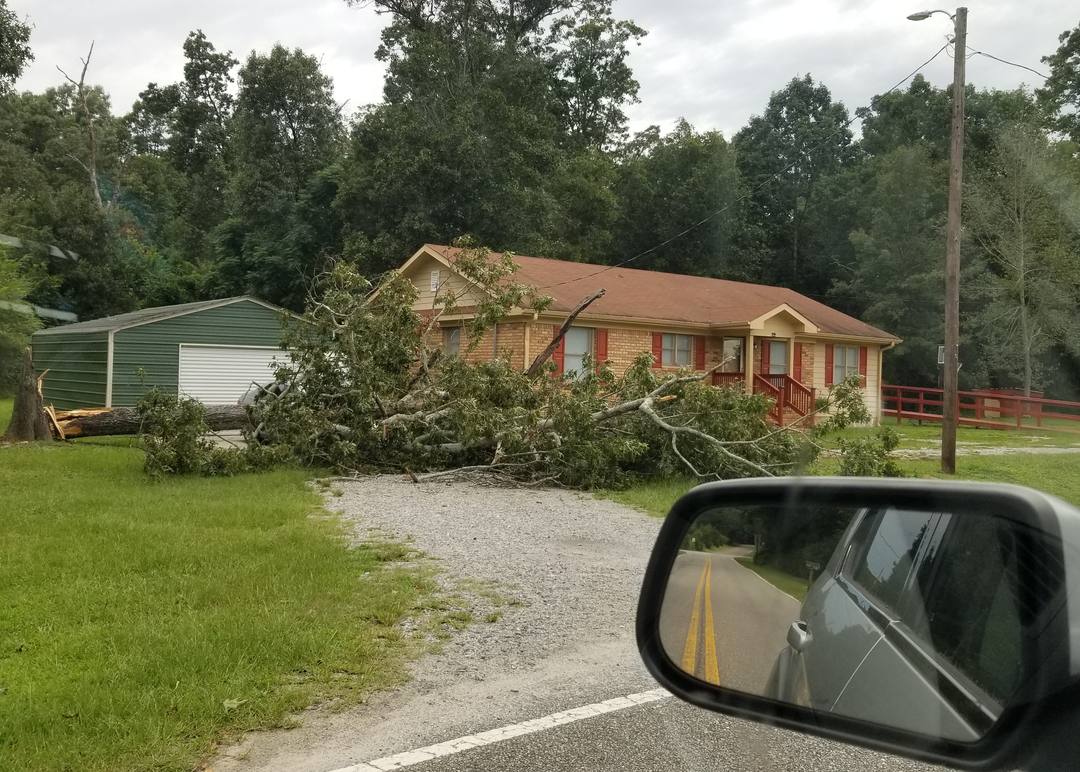
West-side lake properties get open-water wind exposure and wetter ground in the coves and draws. Heavy clay with a perched water table means water sits, and trees standing in ground that has been saturated for days are the ones that go over when a tropical system's remnants come through. Which trees can handle wet feet and which are simply in the wrong place is worth knowing before the next storm rather than after.
Services
Reviews
I can’t say enough great things about this company! They were incredibly friendly, professional, and truly a breath of fresh air to work with. They safely removed a dead tree from my property and even went above and beyond by neatly stacking the wood for me to use as firewood this year. Their prices were very fair, and the quality of their work exceeded my expectations. The Arborist (billy) helped me identify every tree on my property. If you’re looking for a reliable, honest, educated and skilled tree service, I highly recommend Branching Out Arboreal and Native Plant Specialists — you won’t be disappointed!Victoria Tillman · 8 months ago
Branching Out did an amazing job removing a dangerously dead pine tree from our backyard. The tree was right next to power lines, a transformer pole, fences, and close to our home, so it was a very difficult removal with almost no room for error. The tree was so dead it was basically crumbling while they climbed it, but their crew handled everything safely and professionally without causing any damage at all. What made the job even more difficult was that another healthy tree had actually started growing out of the dead pine, and they were able to carefully remove the pine while saving the healthy tree as well. A few weeks later, another company working nearby actually dropped a tree into power lines and took down a transformer pole — which made us even more grateful we hired Branching Out. These guys clearly know what they’re doing. Highly recommend them for any tree removal or dangerous tree work.Kenzi Standley · 2 months ago
First I want to say Branching Out is a professional company. After talking to Billy he sent me a printed quote for the work we had viewed and discussed . He removed three trees for us. His price was far more reasonable than the three other verbal quotes I had received. Also the other companies came back with lower offers after their bids were rejected. The bids were still not as low as Branching Out. The job was done super well and we enjoyed working with his whole crew, including his associate Tyler who did the stump grinding.Judy Price · a month ago
They did an excellent job cutting down a tall dead pine that was in a tight spot—no one’s favorite thing to do! Great communication, friendly, professional, and courteous. We had a challenge finding someone to service our area, so we are grateful and would highly recommend.everyotherone12 · a year ago
I was trying to save a tree and most companies want to just cut them down. But Kat & Billy went over and beyond to help me save my tree. They had to cut off alot more of the rotton branches than expected. But at least I should be able to keep this tree for were hoping another 5 yrs so I have time to get another one planted and growing before I lose this one. It's my only shade tree. They were very reasonable in thier prices and very knowledgeable. Would definitely use them again and refer them out. Thanks guysKim Taylor · a year ago
Reviews from Google · read them all
Nearby
Questions
Construction and grade changes, by a distance. Anything that compacts, cuts or buries the root zone — and the root zone extends well beyond the branch spread. Protecting it during any project on the property is worth more than every other form of tree care combined. After that, spring pruning cuts on oaks and the oak wilt risk they carry.
Yes, with access arranged ahead of time and any required approvals in hand. Tell us what your association requires when you call and it can be built into the scheduling rather than discovered on the day.
Not naturally. A healthy East Texas woodlot has layers — canopy, small trees, shrubs and ground plants. Bare ground under a canopy usually means privet has taken and then been cleared, or that the understory is being mowed, or that deer pressure is heavy. If it is privet, the fix is removing the mature plants, treating the stumps so they do not resprout, and getting natives established while the space is open.
Match the space to the mature size, not the sapling. Where there is genuine room, a southern red oak or a properly sited native shade tree. Where there is not, Texas redbud or another small native does the job without becoming next generation's removal. Either way, plant in fall or winter and keep the root flare at grade — planting depth kills more replacement trees around here than anything that happens afterward.
Yes, and Montgomery's mix of wooded lots and open acreage suits them. Shade beds of beautyberry and Turk's cap under existing canopy, sun plantings of coneflower, black-eyed Susan and milkweed where the light is, and edible gardens integrated into the same design rather than sitting off in a separate fenced rectangle.
Get in touch
Call and talk to someone who does the work, or send the details and we'll get back to you.
Call (936) 648-2843