 Free quote
Free quote
Free quote
Madison County
Tree removal, land clearing and storm work in Madisonville and Madison County — post oak ranch land, cedar, fence lines. 24/7 emergencies.
Madisonville is ranch country with a town in the middle of it. Most of Madison County is pasture, hay meadow and post oak woods, crossed by creeks running down to the Trinity on the east side and the Navasota on the west. The tree work here is as much about land as it is about yards: fence lines, pasture edges, creek banks, barns and the long drives out to houses set well back from the road.
Call (936) 648-2843 for anything in Madisonville, Midway, Normangee, North Zulch or anywhere else in Madison County. Storm calls are answered 24/7.
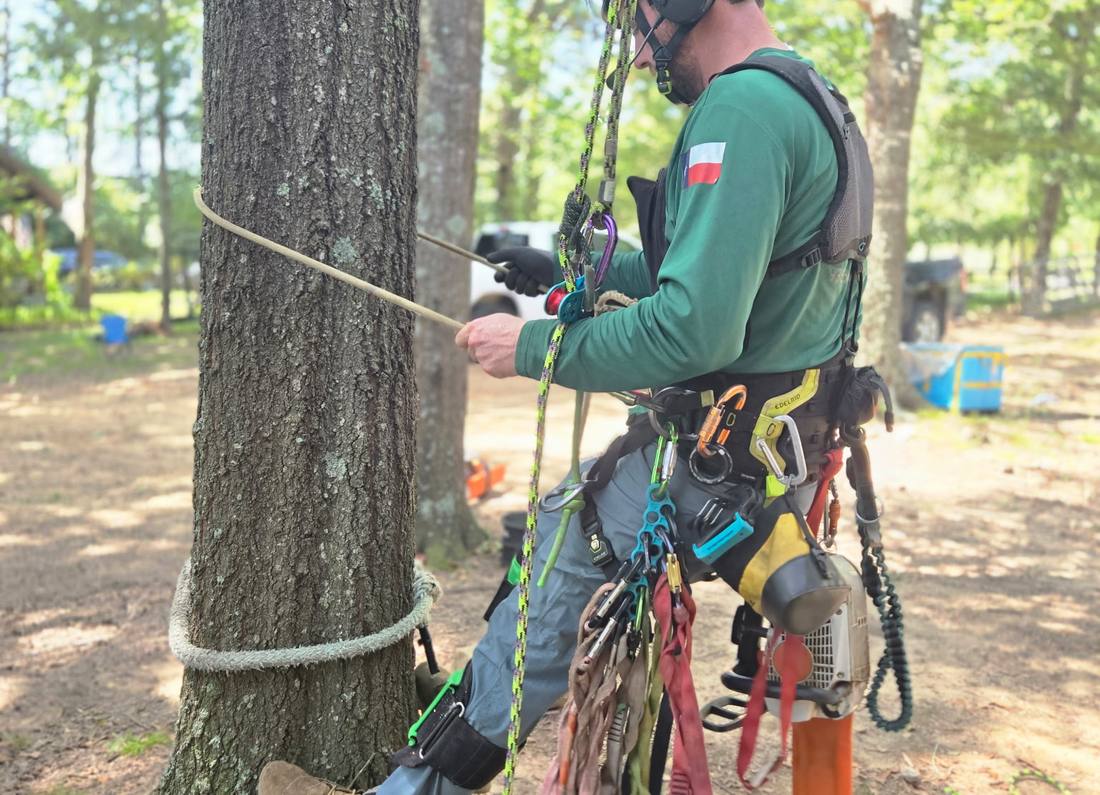
The native tree here is the post oak, with blackjack oak on the poorer, sandier ground. Both are slow-grown, tough and long-lived, which is why so many big ones are still standing in pastures and around old homesteads. They are also the trees people most often lose by accident.
Post oaks do not tolerate having their roots disturbed. Grading around a new house, parking trucks and trailers under them, spreading fill over the root zone, or trenching a line past them can kill a tree that has stood for a hundred years, and it does so slowly, over three to five summers. By the time the top thins out, the damage is long done. If you are building or clearing near good oaks, mark them and keep the equipment out from under the canopy. A conversation before the work starts is worth far more than a removal after it.
Leave a pasture alone for a few years and it does not stay a pasture. Eastern red cedar, yaupon and sweetgum seedlings move in first, then the thicket fills in, and the grazing or hay ground shrinks a little every year. On wetter ground Chinese tallow does the same thing faster, especially around stock tanks and along creeks.
Taking that back is part of the job. It means selective clearing rather than scraping everything flat: removing the cedar and brush, treating the tallow so it does not resprout from the stump, and leaving the good hardwoods standing. Done that way, the land comes back as pasture with shade, rather than bare ground that washes in the first heavy rain.
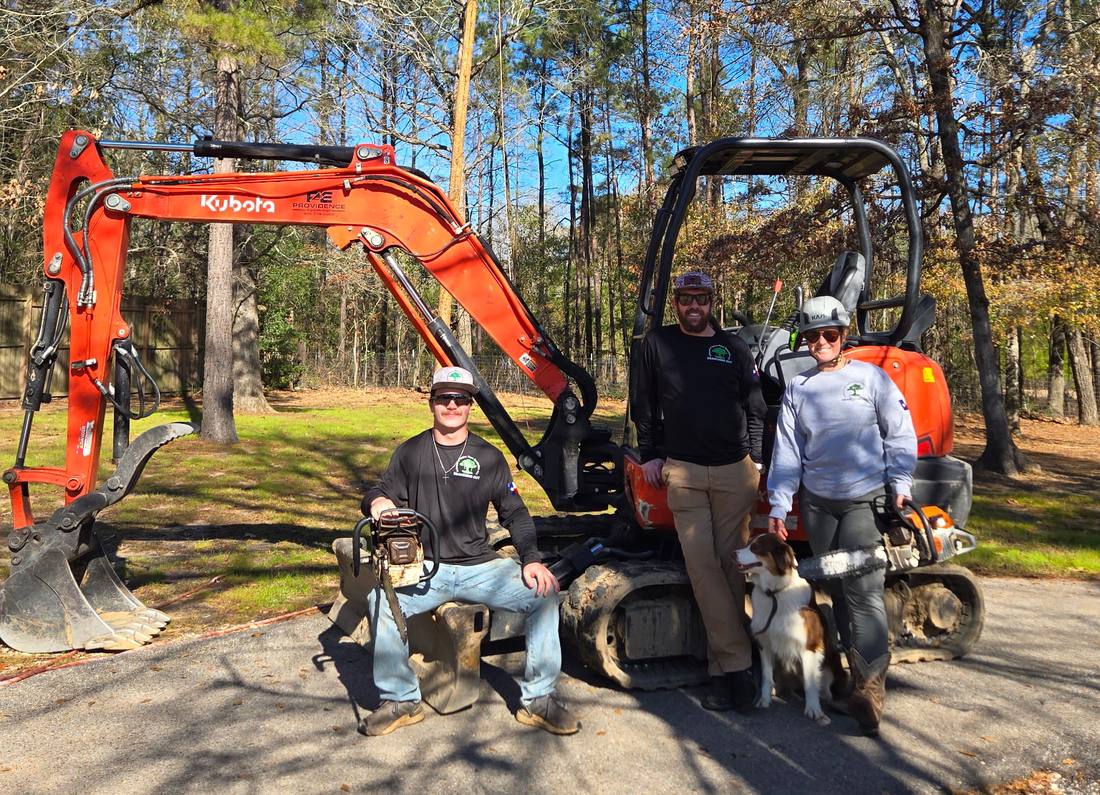
Trees along fence lines are a constant source of work in a county like this. Limbs come down on the wire, a dead oak falls across the fence and lets the cattle out, and the brush along the line grows up until nobody can drive it. Clearing a fence line properly means taking the hazard trees and the brush, keeping a clean line wide enough to maintain, and dealing with the cut stumps so they do not come back in a single season.
Long drives have the same problem from the other direction. A dead or leaning tree over the only way in and out of a property is not a nuisance, it is a problem the first time a storm puts it across the road with you on the wrong side of it.
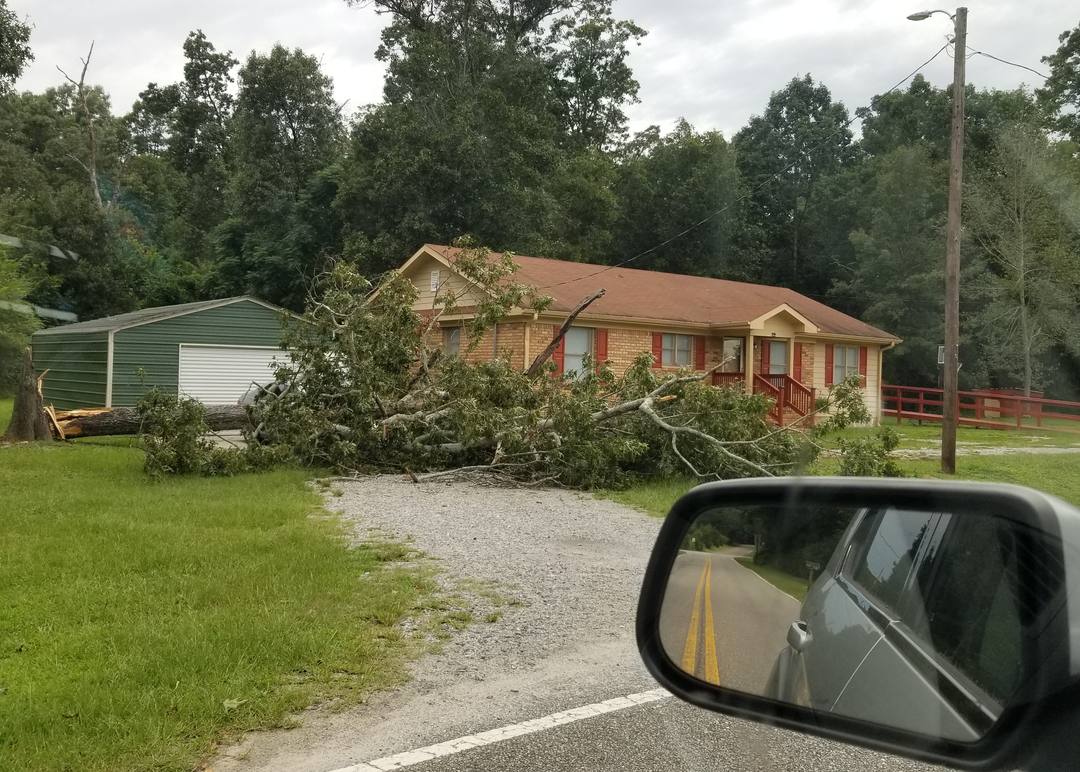
I-45 runs straight through Madisonville, and so does a lot of weather. Tropical systems coming up from the Gulf are still carrying wind and heavy rain when they reach this far north, and spring storm lines bring straight-line wind and the odd tornado warning. Open pasture country gives that wind a long run at isolated trees and fence lines, and an old oak standing alone takes the full force of it.
When a storm comes through, the first jobs are the ones that block access or put a tree on a house or barn. We answer the phone 24/7 for exactly those calls.
Much of Madison County is sandy loam over a clay subsoil, which drains well enough on top and then stops. In a wet spring the water perches on the clay and the root zone stays saturated; in August the ground cracks. Trees standing in ground that has been wet for a week lose their grip, and that is when wind does the most damage. Low corners that never dry out are also where drainage work and the right native plantings do more good than another round of mowing around a puddle.
Services
Reviews
I can’t say enough great things about this company! They were incredibly friendly, professional, and truly a breath of fresh air to work with. They safely removed a dead tree from my property and even went above and beyond by neatly stacking the wood for me to use as firewood this year. Their prices were very fair, and the quality of their work exceeded my expectations. The Arborist (billy) helped me identify every tree on my property. If you’re looking for a reliable, honest, educated and skilled tree service, I highly recommend Branching Out Arboreal and Native Plant Specialists — you won’t be disappointed!Victoria Tillman · 8 months ago
Branching Out did an amazing job removing a dangerously dead pine tree from our backyard. The tree was right next to power lines, a transformer pole, fences, and close to our home, so it was a very difficult removal with almost no room for error. The tree was so dead it was basically crumbling while they climbed it, but their crew handled everything safely and professionally without causing any damage at all. What made the job even more difficult was that another healthy tree had actually started growing out of the dead pine, and they were able to carefully remove the pine while saving the healthy tree as well. A few weeks later, another company working nearby actually dropped a tree into power lines and took down a transformer pole — which made us even more grateful we hired Branching Out. These guys clearly know what they’re doing. Highly recommend them for any tree removal or dangerous tree work.Kenzi Standley · 2 months ago
First I want to say Branching Out is a professional company. After talking to Billy he sent me a printed quote for the work we had viewed and discussed . He removed three trees for us. His price was far more reasonable than the three other verbal quotes I had received. Also the other companies came back with lower offers after their bids were rejected. The bids were still not as low as Branching Out. The job was done super well and we enjoyed working with his whole crew, including his associate Tyler who did the stump grinding.Judy Price · a month ago
They did an excellent job cutting down a tall dead pine that was in a tight spot—no one’s favorite thing to do! Great communication, friendly, professional, and courteous. We had a challenge finding someone to service our area, so we are grateful and would highly recommend.everyotherone12 · a year ago
I was trying to save a tree and most companies want to just cut them down. But Kat & Billy went over and beyond to help me save my tree. They had to cut off alot more of the rotton branches than expected. But at least I should be able to keep this tree for were hoping another 5 yrs so I have time to get another one planted and growing before I lose this one. It's my only shade tree. They were very reasonable in thier prices and very knowledgeable. Would definitely use them again and refer them out. Thanks guysKim Taylor · a year ago
Reviews from Google · read them all
Nearby
Questions
No. Madison County touches Walker County, and we work every county that does. Madisonville is straight up I-45 from Huntsville. Call and tell us what you have.
Yes, and in most cases that is the better way to do it. Selective clearing keeps the good hardwoods for shade and soil, removes the cedar and brush, and treats the invasives so they do not come straight back. Scraping a pasture bare tends to trade one problem for erosion and a fresh crop of seedlings.
It may well be. Post oaks are the classic victim of construction damage, and the decline usually starts a year or more after the work. Someone needs to look at the tree, the grade around it and what happened in the root zone before deciding whether it can be helped or has to come down safely before it falls on the new house.
No. Land work depends on access, density, what is underneath the brush and what you want to keep. Someone walks the property and you get a written price before any work is scheduled.
Old homesteads in Madison County often have the biggest trees in the area: pecans and live oaks planted a century ago, cedars along an old drive, a post oak that was spared when the land was cleared. They are worth keeping wherever they are sound, and they are also where the dead limbs, the hollow trunks and the lightning-struck tops tend to be. A walk around the house, the barn and the drive with someone who can tell a declining tree from an old but healthy one is the place to start. Most of the time the answer is deadwood removal and clearance over the roof, not removal, and it costs a fraction of what a fallen limb through a barn roof costs.
Call (936) 648-2843, day or night for storm damage.
Get in touch
Call and talk to someone who does the work, or send the details and we'll get back to you.
Call (936) 648-2843