 Free quote
Free quote
Free quote
Montgomery County
Tree removal, pruning and native plantings in The Woodlands — covenant approvals, preserved loblolly pines, tight lot access and rigging over rooflines.
The Woodlands is the only place we work where the trees came first and the houses were fitted around them. That is the whole appeal of living here, and it is also why tree work in these villages is a different job than it is ten miles up I-45. The pines standing over these houses are original forest that was deliberately left in place, they are now decades older than they were on the day the lot sold, and a good number of them are within falling distance of a roof.
Call (936) 648-2843 for tree work anywhere in The Woodlands.
A loblolly that grew up inside a closed forest canopy grew tall and narrow because it was competing for light on every side. It has a small crown at the top of a long clean trunk, and almost no taper. That shape is entirely stable while its neighbours are still standing — the whole stand shelters itself and moves as one.
Then a neighbourhood gets built into it. Lots are cleared, streets go in, houses open gaps in the canopy, and individual trees that spent fifty years sheltered are suddenly standing alone on the windward edge of a clearing. A tree that grew in shelter does not have the trunk taper or the root plate to stand exposed, and it cannot retroactively build them fast enough to matter.
This is the single most useful thing to understand about a Woodlands lot. The tallest, straightest, most impressive pine on your property is often the one carrying the most risk, and not because there is anything wrong with it. Its shape was correct for the forest it grew in and that forest is not there anymore.
Residential property in The Woodlands is covered by deed covenants administered through the Township, and removing a healthy tree from a residential lot generally means an application and an approval before any work happens. Standards are not identical across the villages, and what applies to your lot in Alden Bridge is not automatically what applies in Grogan's Mill or Creekside Park.
Read your own covenant documents, or call Covenant Administration before you schedule anything. We would much rather quote a job, wait for your approval to come through, and then do the work, than show up and take down a tree you were not cleared to remove. Dead, dying and genuinely hazardous trees are usually treated differently from healthy ones, which is worth knowing if what you are looking at is a pine that has already gone brown.
Where a removal comes with a replacement-planting requirement, that is not a penalty. It is a chance to put the right species in a place you actually chose, instead of accepting whatever seedling the forest volunteers into that spot.
A recurring Woodlands call is about a tree that turns out not to be on the caller's lot. The greenbelts, pathways and forested reserves running between and behind these neighbourhoods are common area, and the trees in them are not yours to cut, even where one is leaning over your fence.
If a reserve tree genuinely threatens your house, that is a conversation with the Township rather than with us, and it is worth starting early because it will not be a same-week resolution. What you can do on your own side of the line is different from what you can do past it, and we will tell you plainly which one you are looking at.
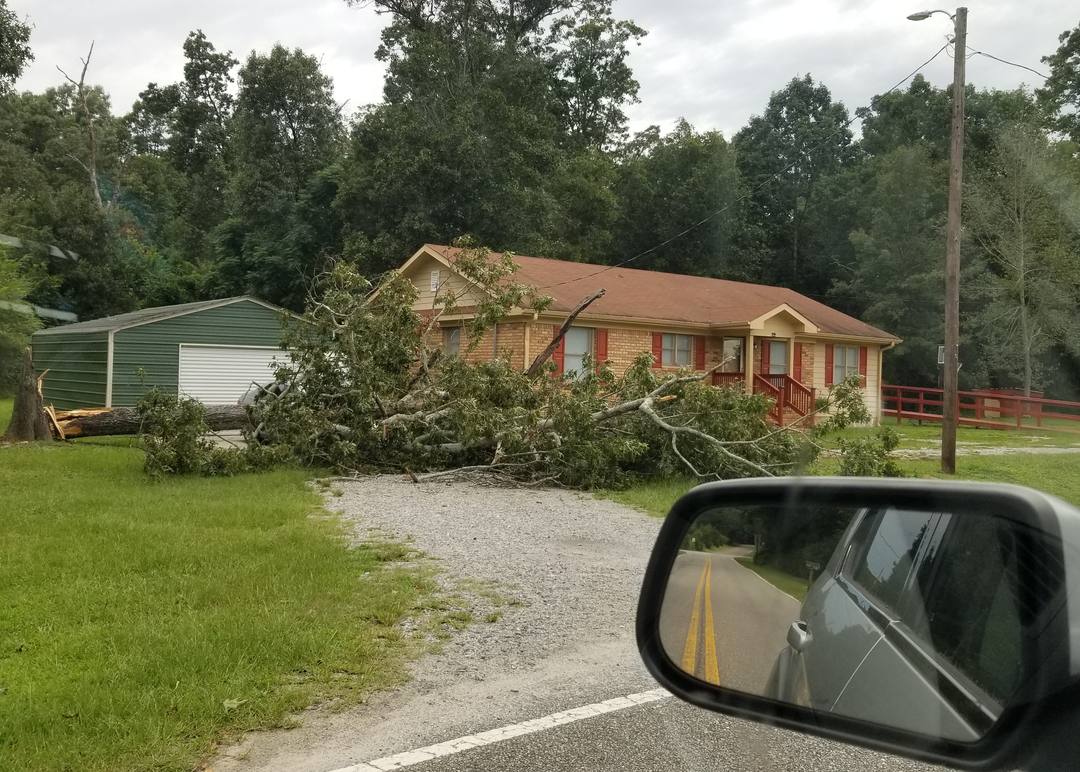
Lots in the villages are close together, the driveways are short, the trees are tall, and the pool, the deck and the neighbour's roof are all inside the drop zone. A pine that could be felled whole in twenty seconds on an acre outside New Waverly has to come down in sections over a roofline here, rigged and lowered piece by piece.
That is slower and it costs more, and any quote that ignores it is a quote from someone who has not looked at the site. It is also where the difference between crews actually shows: protecting the lawn, the beds, the irrigation heads and the septic or utility runs on the way in and out is planning, not luck.
Services
Reviews
I can’t say enough great things about this company! They were incredibly friendly, professional, and truly a breath of fresh air to work with. They safely removed a dead tree from my property and even went above and beyond by neatly stacking the wood for me to use as firewood this year. Their prices were very fair, and the quality of their work exceeded my expectations. The Arborist (billy) helped me identify every tree on my property. If you’re looking for a reliable, honest, educated and skilled tree service, I highly recommend Branching Out Arboreal and Native Plant Specialists — you won’t be disappointed!Victoria Tillman · 8 months ago
Branching Out did an amazing job removing a dangerously dead pine tree from our backyard. The tree was right next to power lines, a transformer pole, fences, and close to our home, so it was a very difficult removal with almost no room for error. The tree was so dead it was basically crumbling while they climbed it, but their crew handled everything safely and professionally without causing any damage at all. What made the job even more difficult was that another healthy tree had actually started growing out of the dead pine, and they were able to carefully remove the pine while saving the healthy tree as well. A few weeks later, another company working nearby actually dropped a tree into power lines and took down a transformer pole — which made us even more grateful we hired Branching Out. These guys clearly know what they’re doing. Highly recommend them for any tree removal or dangerous tree work.Kenzi Standley · 2 months ago
First I want to say Branching Out is a professional company. After talking to Billy he sent me a printed quote for the work we had viewed and discussed . He removed three trees for us. His price was far more reasonable than the three other verbal quotes I had received. Also the other companies came back with lower offers after their bids were rejected. The bids were still not as low as Branching Out. The job was done super well and we enjoyed working with his whole crew, including his associate Tyler who did the stump grinding.Judy Price · a month ago
They did an excellent job cutting down a tall dead pine that was in a tight spot—no one’s favorite thing to do! Great communication, friendly, professional, and courteous. We had a challenge finding someone to service our area, so we are grateful and would highly recommend.everyotherone12 · a year ago
I was trying to save a tree and most companies want to just cut them down. But Kat & Billy went over and beyond to help me save my tree. They had to cut off alot more of the rotton branches than expected. But at least I should be able to keep this tree for were hoping another 5 yrs so I have time to get another one planted and growing before I lose this one. It's my only shade tree. They were very reasonable in thier prices and very knowledgeable. Would definitely use them again and refer them out. Thanks guysKim Taylor · a year ago
Reviews from Google · read them all
Nearby
Questions
For a healthy tree on a residential lot, generally yes — The Woodlands runs on deed covenants and there is an application process before removal. Dead, dying and hazardous trees are usually handled differently. Check with Covenant Administration or read your village's standards before scheduling, and we will work around whatever timeline your approval takes.
Loblollies across this area go through the same droughts and the same wet years together, and stressed pines attract bark beetles, which then move through a stand of similarly stressed neighbours. When one goes brown, look at the ones around it. The tell is thinning at the very top of the crown, a dull cast to the whole tree, and popcorn-sized pitch tubes on the trunk. A pine that far gone does not come back, and it gets more expensive to remove every month it stands, because dead wood cannot be climbed and has to be reached another way.
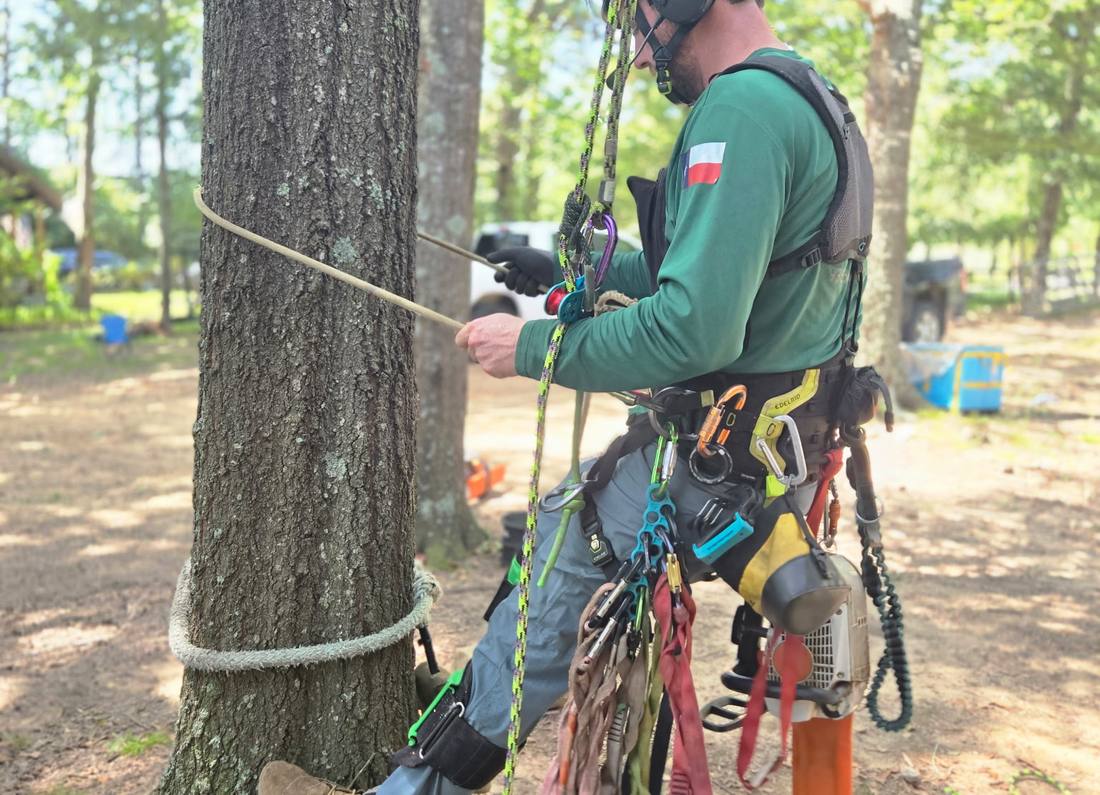
That is the standard job in The Woodlands, and it is done by rigging: climbing or lifting into the tree, cutting it down in pieces, and lowering each piece under control rather than dropping it. It takes longer than a straight fell and it is priced accordingly. What we will not do is take on a drop that we do not think can be landed safely — if the answer is a crane, we will say so before you have paid for anything.
Shade and acidic, needle-covered soil rule out a lot of nursery ornamentals, which is why so many Woodlands beds struggle. Native understorey species evolved for exactly this: American beautyberry, Turk's cap, inland sea oats, wax myrtle and possumhaw for winter berries. They handle the shade, they handle the clay, and they feed the birds and pollinators the greenbelt population already depends on.
Chinese tallow, Chinese privet and Callery pear all seed into forest edges here, and a back fence line against a reserve is the usual entry point. Tallow will take a shaded understorey outright if nothing interrupts it. Cutting one down without treating the stump gets you a multi-stemmed thicket in its place, which is why this is worth doing properly once rather than repeatedly with a mower.
Get in touch
Call and talk to someone who does the work, or send the details and we'll get back to you.
Call (936) 648-2843