 Free quote
Free quote
Free quote
Pruning & Trimming
Structural pruning, deadwood and roof clearance for East Texas oaks, pines and crape myrtles — timed to help the tree. Call (936) 648-2843.
Good pruning starts with a reason. Clearance over a roof, removing dead or broken limbs, opening a young tree up so it grows a strong framework, reducing a limb that is over-extended — each of those is a specific objective with a specific set of cuts. "Trim it back" is not an objective, and pruning without one is how trees get damaged by the people hired to take care of them.
Call (936) 648-2843 and we will tell you what a tree needs, including when the answer is nothing.
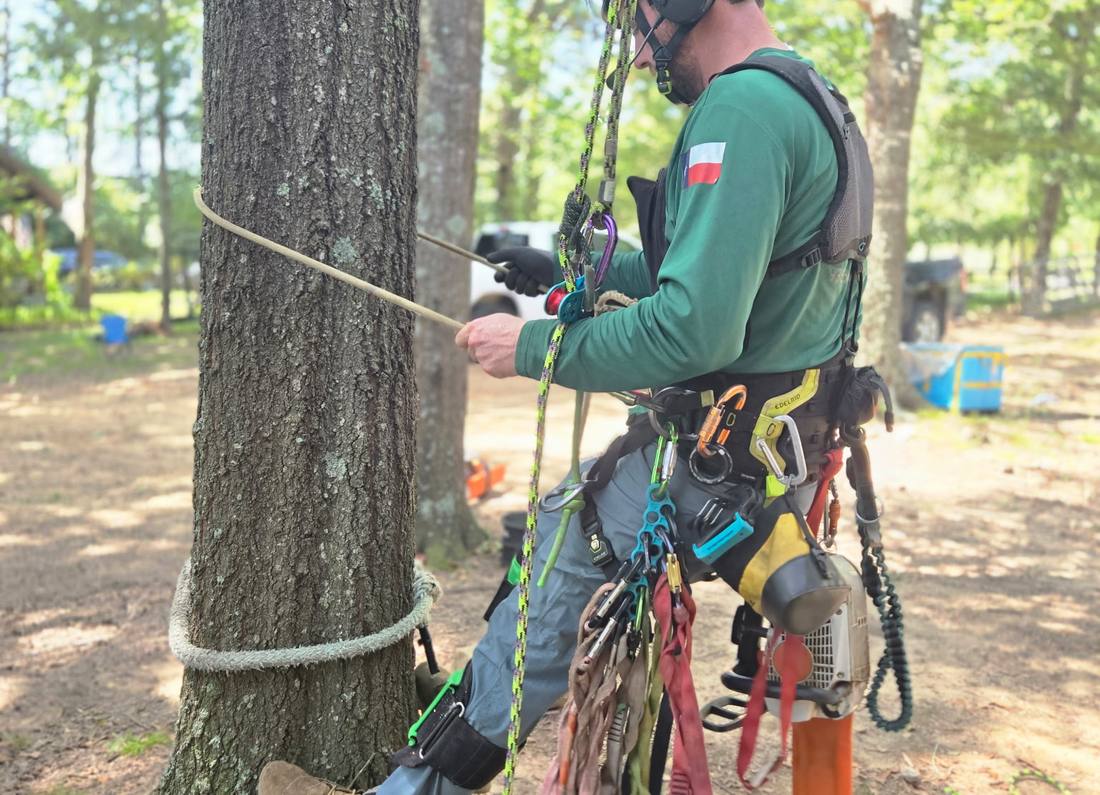
Deadwood removal. Dead limbs come out because they fall eventually and because their attachment points are entry routes for decay. This is the single most useful thing you can do for a mature shade tree, and on a big water oak or post oak it often removes the whole hazard without touching live wood.
Structural pruning on young trees. A ten-year-old tree with two competing leaders and a tight, bark-included fork is a thirty-year-old tree that splits down the middle in a windstorm. Correcting that early costs a fraction of dealing with it later, and the cuts are small enough to close over quickly.
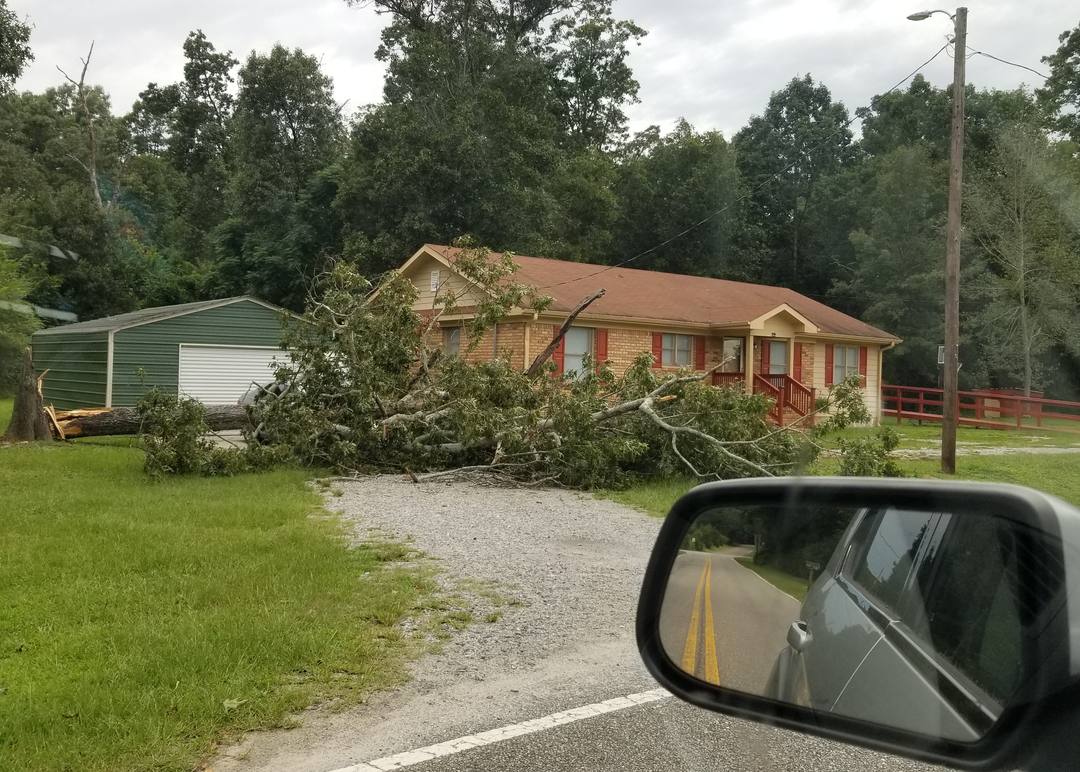
Clearance. Limbs off the roof, off the gutters, off the driveway, away from the service drop. In this climate, branches resting on shingles hold moisture and give squirrels and roof rats a bridge, so clearance is a building maintenance issue as much as a tree one.
Reduction, not topping. An over-extended limb can be shortened back to a suitable lateral branch that becomes the new end of the limb. That is reduction. Cutting the limb off in the middle of nowhere is topping, and it produces a cluster of weakly attached regrowth that is more dangerous than what was there before.
The default window for structural work in East Texas is dormancy — roughly late fall through winter. The tree is not spending energy on leaves, the structure is visible, and wound closure begins as growth resumes.
Oaks are the exception worth taking seriously. Across Texas the guidance is to avoid pruning oaks during the spring window when oak wilt is most readily spread by sap-feeding beetles moving between fresh wounds — generally February through June. When an oak has to be pruned in that window because of a genuine hazard, the cuts get sealed immediately. That is one of the few cases where wound paint is the right call rather than a myth.
Storm damage is its own category. Broken limbs get cleaned up whenever they happen, because a torn stub is worse for the tree than a clean cut in the wrong season.
We do not top trees. Topping a pine effectively kills it as a landscape tree — loblolly and shortleaf do not regenerate a leader from a headed trunk the way some hardwoods will attempt to.
We do not lion-tail, which is stripping the interior branches off a limb and leaving a tuft at the end. It looks tidy from the ground and it is genuinely harmful: the limb loses its interior foliage, puts all the weight and wind sail at the far end, and becomes more likely to fail, not less.
And we do not cut crape myrtles off at knee height. There is a reason that practice has a nickname.
Included
Typical range: Quoted per property
Reviews
I can’t say enough great things about this company! They were incredibly friendly, professional, and truly a breath of fresh air to work with. They safely removed a dead tree from my property and even went above and beyond by neatly stacking the wood for me to use as firewood this year. Their prices were very fair, and the quality of their work exceeded my expectations. The Arborist (billy) helped me identify every tree on my property. If you’re looking for a reliable, honest, educated and skilled tree service, I highly recommend Branching Out Arboreal and Native Plant Specialists — you won’t be disappointed!Victoria Tillman · 8 months ago
Branching Out did an amazing job removing a dangerously dead pine tree from our backyard. The tree was right next to power lines, a transformer pole, fences, and close to our home, so it was a very difficult removal with almost no room for error. The tree was so dead it was basically crumbling while they climbed it, but their crew handled everything safely and professionally without causing any damage at all. What made the job even more difficult was that another healthy tree had actually started growing out of the dead pine, and they were able to carefully remove the pine while saving the healthy tree as well. A few weeks later, another company working nearby actually dropped a tree into power lines and took down a transformer pole — which made us even more grateful we hired Branching Out. These guys clearly know what they’re doing. Highly recommend them for any tree removal or dangerous tree work.Kenzi Standley · 2 months ago
First I want to say Branching Out is a professional company. After talking to Billy he sent me a printed quote for the work we had viewed and discussed . He removed three trees for us. His price was far more reasonable than the three other verbal quotes I had received. Also the other companies came back with lower offers after their bids were rejected. The bids were still not as low as Branching Out. The job was done super well and we enjoyed working with his whole crew, including his associate Tyler who did the stump grinding.Judy Price · a month ago
They did an excellent job cutting down a tall dead pine that was in a tight spot—no one’s favorite thing to do! Great communication, friendly, professional, and courteous. We had a challenge finding someone to service our area, so we are grateful and would highly recommend.everyotherone12 · a year ago
I was trying to save a tree and most companies want to just cut them down. But Kat & Billy went over and beyond to help me save my tree. They had to cut off alot more of the rotton branches than expected. But at least I should be able to keep this tree for were hoping another 5 yrs so I have time to get another one planted and growing before I lose this one. It's my only shade tree. They were very reasonable in thier prices and very knowledgeable. Would definitely use them again and refer them out. Thanks guysKim Taylor · a year ago
Reviews from Google · read them all
Coverage
What this job looks like in Conroe specifically.
Questions
Less than most people assume. A mature, healthy tree can generally give up a modest share of its live canopy in a season without stress; a tree already suffering from drought, root damage or construction disturbance should give up much less than that. Live foliage is how the tree feeds itself, so aggressive removal is a withdrawal from an account that is already low. Deadwood does not count toward that — you can take all of it.
Selective work does. Removing dead and broken limbs, reducing an over-extended scaffold, and correcting a bad union all lower the odds of failure. Wholesale thinning does not, and the popular idea that a tree should be opened up to "let the wind through" is not how tree failure works. Whole-tree failures around here are usually root plate failures in saturated clay, which no amount of canopy thinning fixes.
Remove suckers at the base, take out crossing and rubbing interior branches, and cut off the old seed heads if you want to. That is it. Cutting the main stems back to stubs every winter produces a burst of long whippy shoots that flop over when they bloom and get heavier every year, and it destroys the smooth exfoliating bark that is the best feature of the plant.
Mostly just clearance and deadwood. Pines shed their lower limbs naturally as they grow, and a healthy loblolly needs very little help. What pines do need is attention to what is happening at the top: a thinning crown, fading color or pitch tubes on the trunk points to stress and possible bark beetle activity, and that is a health assessment rather than a pruning job.
Not usually, as long as we have access and know what you want done. Walking the property together first is better, though — pointing at the specific limb over the bedroom beats describing it, and it is the fastest way to make sure the finished result is the one you had in mind.
Get in touch
Call and talk to someone who does the work, or send the details and we'll get back to you.
Call (936) 648-2843