 Free quote
Free quote
Free quote
Storm & Disaster Relief · Huntsville
Emergency tree response in Huntsville and Walker County after wind and flooding — hangers, leaners, trees on roofs. (936) 648-2843.
After a storm in Huntsville, do three things before you call anyone. Stay clear of anything touching a power line and report it to the utility. Get people and vehicles out from under damaged canopy, because the limb that survived the storm is often the one that comes down the next afternoon. Then photograph everything from several angles before a branch is moved, since that is what an adjuster will want.
Then call (936) 648-2843 and we will work out what has to happen first.
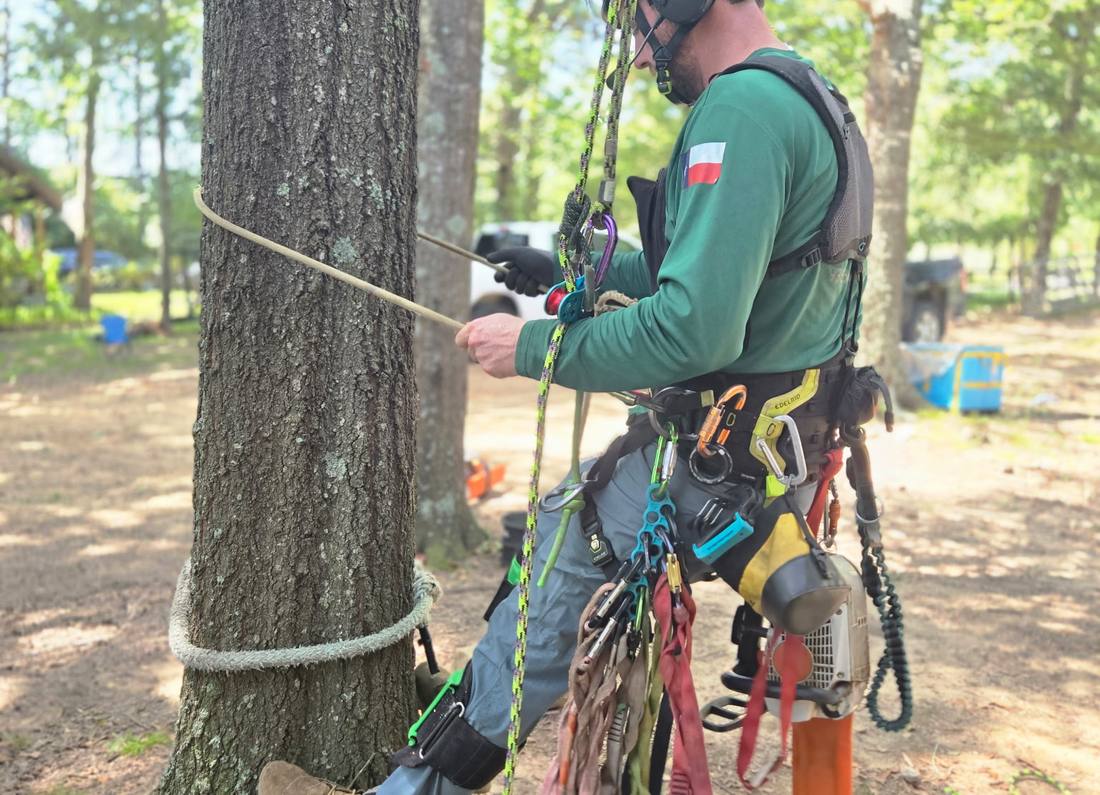
Huntsville sits far enough inland that surge is not the threat. What arrives here is a weakening tropical system that still carries substantial wind, dragging rain that lasts for days rather than hours.
That combination targets our soil. Walker County clay and clay-loam drain slowly and hold water at the surface, and a perched water table means the ground can stay saturated well below the root zone. Saturated soil loses its shear strength. A loblolly pine with a broad crown and a shallow root plate does not need remarkable wind to go over once the ground has taken a foot of rain — it needs ordinary wind at the wrong moment.
So Huntsville's storm damage is disproportionately uprooted pines rather than snapped trunks. The hardwood failures are different: the mature water oaks over these older neighborhoods break at defects that were already there, usually internal decay in a trunk or a major scaffold that the green canopy was hiding.
There is also a delayed effect. Trees carrying drought damage — the 2011 drought still shows in East Texas pine — hold weakened roots and accumulated deadwood for years, and a storm is when that comes due all at once.
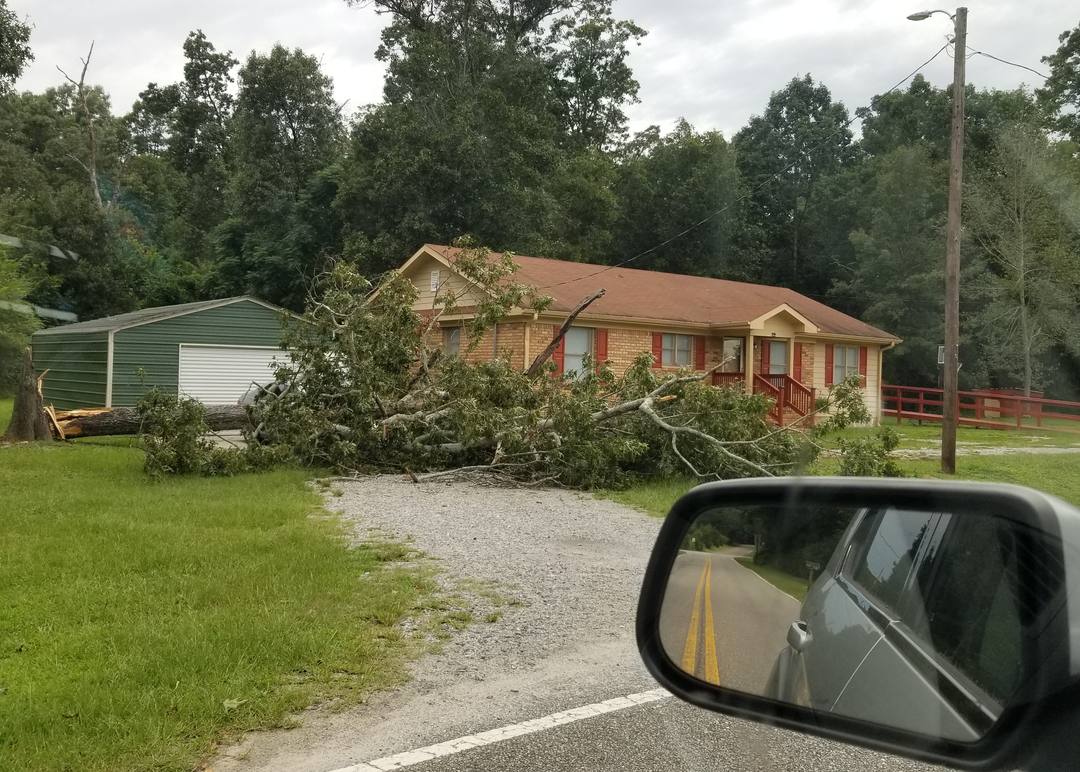
Hangers. A limb torn loose and lodged in the canopy is the most common post-storm hazard here and the one people most often walk underneath without thinking about it. Those come out from a rope, not from a ladder.
Leaners and partial uprootings. Fresh soil cracking or mounding at the base means the root plate has already moved. The tree is under load, and cutting it in the wrong sequence releases that load in whatever direction it wants — including sideways.
Trees on structures. Taking weight off a roof, a fence or a vehicle in an order that does not add damage on the way out.
Blocked access. Driveways and streets cleared so you can get out and so anyone else you need can get in.
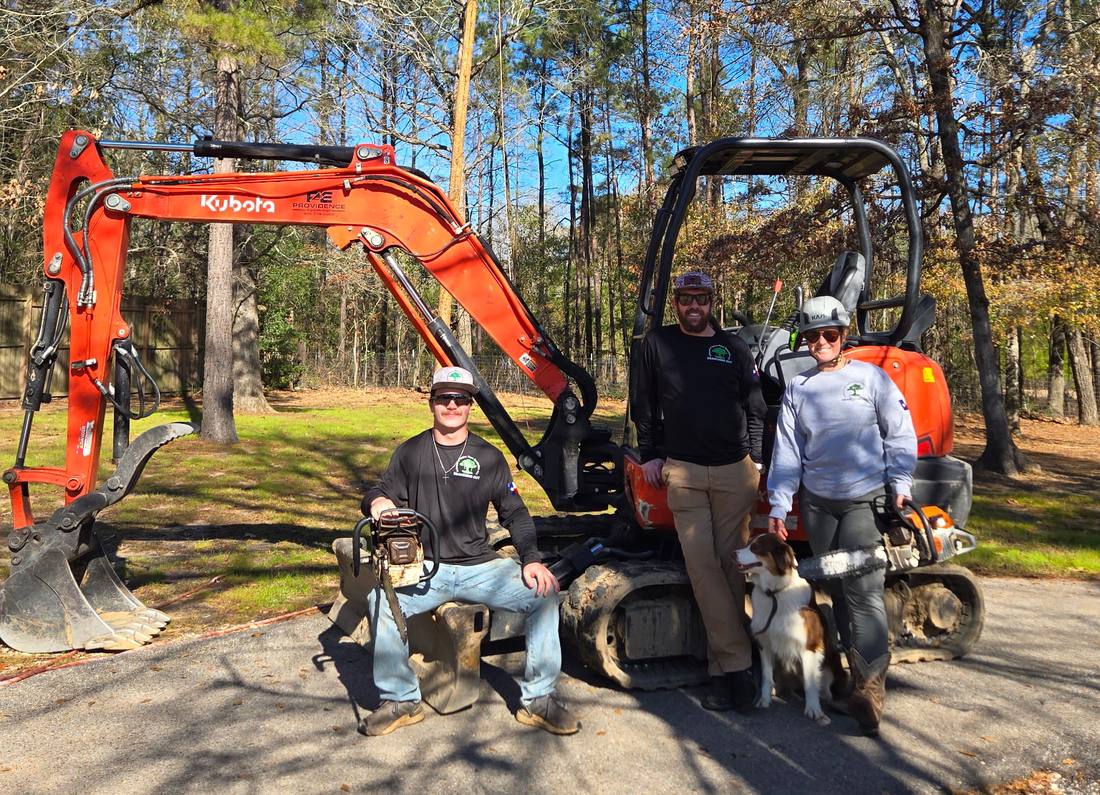
The older parts of town — around the historic core, near the university — have narrow streets, tight lots, alleys, and detached garages. After a storm, add a tree across the road and utility crews working the same block, and simply getting equipment to the tree becomes half the job.
The rental stock around the university adds a coordination problem of its own, since the person under the tree and the person who owns it are often not the same person. Getting the owner's authorisation early keeps the work from stalling.
Standing water does damage that surfaces months later. Roots need oxygen, and saturated soil has none — a few days is survivable for most species, weeks is not. Trees that drowned often leaf out the following spring and then decline through summer, which is why a tree that "made it" deserves a second look a year later.
Floodwater mitigation is the same conversation running forward instead of backward: where water collects on your property, how it leaves, what is holding the soil, and which trees are standing in ground that will not hold them next time.
Local conditions
Walker County takes hurricane remnants as wind plus days of rain onto heavy clay, so Huntsville's storm damage is mostly uprooted pines and decayed water oaks failing over small, mature-canopy lots.
Reviews
I can’t say enough great things about this company! They were incredibly friendly, professional, and truly a breath of fresh air to work with. They safely removed a dead tree from my property and even went above and beyond by neatly stacking the wood for me to use as firewood this year. Their prices were very fair, and the quality of their work exceeded my expectations. The Arborist (billy) helped me identify every tree on my property. If you’re looking for a reliable, honest, educated and skilled tree service, I highly recommend Branching Out Arboreal and Native Plant Specialists — you won’t be disappointed!Victoria Tillman · 8 months ago
Branching Out did an amazing job removing a dangerously dead pine tree from our backyard. The tree was right next to power lines, a transformer pole, fences, and close to our home, so it was a very difficult removal with almost no room for error. The tree was so dead it was basically crumbling while they climbed it, but their crew handled everything safely and professionally without causing any damage at all. What made the job even more difficult was that another healthy tree had actually started growing out of the dead pine, and they were able to carefully remove the pine while saving the healthy tree as well. A few weeks later, another company working nearby actually dropped a tree into power lines and took down a transformer pole — which made us even more grateful we hired Branching Out. These guys clearly know what they’re doing. Highly recommend them for any tree removal or dangerous tree work.Kenzi Standley · 2 months ago
First I want to say Branching Out is a professional company. After talking to Billy he sent me a printed quote for the work we had viewed and discussed . He removed three trees for us. His price was far more reasonable than the three other verbal quotes I had received. Also the other companies came back with lower offers after their bids were rejected. The bids were still not as low as Branching Out. The job was done super well and we enjoyed working with his whole crew, including his associate Tyler who did the stump grinding.Judy Price · a month ago
They did an excellent job cutting down a tall dead pine that was in a tight spot—no one’s favorite thing to do! Great communication, friendly, professional, and courteous. We had a challenge finding someone to service our area, so we are grateful and would highly recommend.everyotherone12 · a year ago
I was trying to save a tree and most companies want to just cut them down. But Kat & Billy went over and beyond to help me save my tree. They had to cut off alot more of the rotton branches than expected. But at least I should be able to keep this tree for were hoping another 5 yrs so I have time to get another one planted and growing before I lose this one. It's my only shade tree. They were very reasonable in thier prices and very knowledgeable. Would definitely use them again and refer them out. Thanks guysKim Taylor · a year ago
Reviews from Google · read them all
Questions
We answer 24/7, nights and weekends included. For an isolated storm that hit a few properties, quickly. After a regional event that takes power out across Walker County, every crew in the area is triaging, and the honest sequence is life-safety hazards and blocked access first, trees on structures next, cleanup after. We will tell you where you are in that line rather than name a time we cannot hold.
That is between you and your carrier, and policies vary. What helps is documentation — photographs before anything is cut, from multiple angles, plus a written description of the work performed, which we can provide. We cannot tell you what your policy covers, and anyone promising to handle your claim is offering something they do not control.
Be careful. Storm damage in Walker County pulls in crews from outside the region who work fast, take deposits, and are gone before problems appear. Get the price in writing and know who you are dealing with before anyone touches a tree.
Keep everyone out from under damaged canopy and away from downed lines. Tarp what is open to weather if you can do it from the ground. Take photographs. Move vehicles out of fall zones. Do not put a saw into a limb that is bent or lodged — wood under tension stores an enormous amount of energy and releases it without warning.
Get in touch
Call and talk to someone who does the work, or send the details and we'll get back to you.
Call (936) 648-2843