 Free quote
Free quote
Free quote
Tree Removal · Conroe
Removing construction-stressed pines, split Bradford pears and hazard trees in Conroe subdivisions and around Lake Conroe.
Most tree removal in Conroe traces back to a bulldozer. Montgomery County has been building on ground that was pine forest, and the loblolly pines a builder left standing on each lot begin failing three to five years after the house is finished. Add the Bradford pears that were planted across every subdivision here and are now splitting apart, and you have the two removals that make up the bulk of the work in this town.
Call (936) 648-2843 about a tree in Conroe.
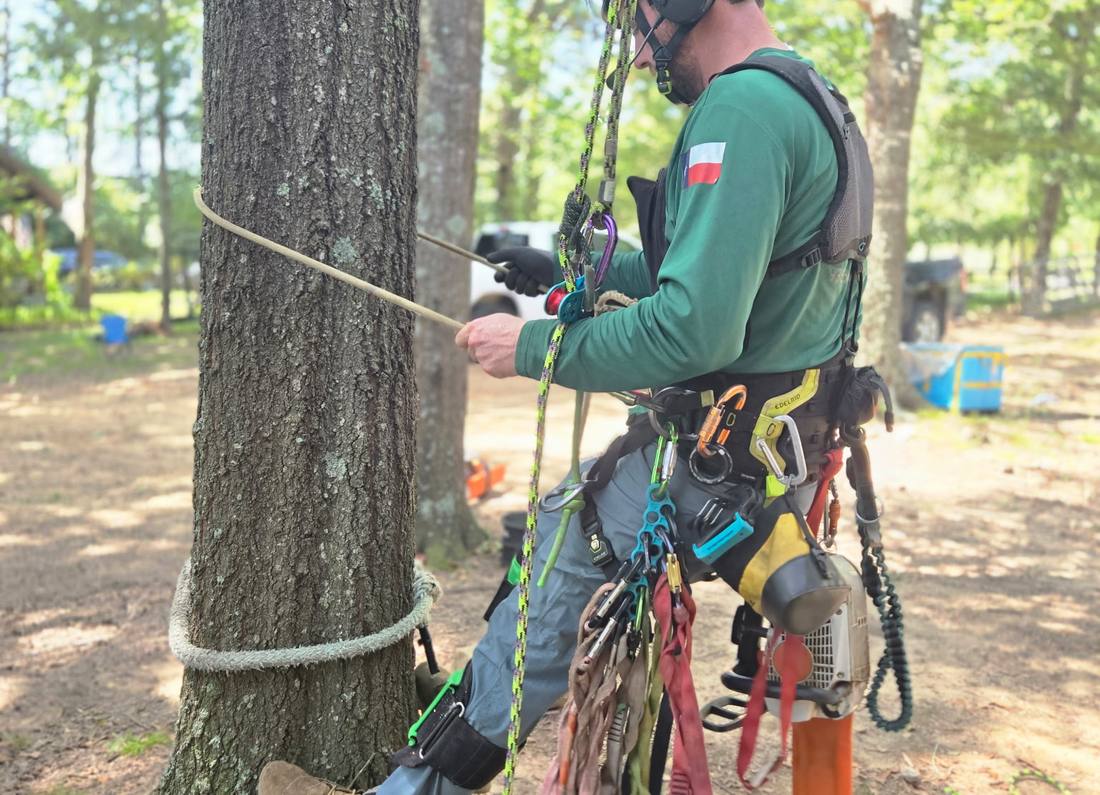
A loblolly's roots sit in the top foot or two of soil and spread far past the branch spread — often two or three times the crown radius. Building a house means trenching utilities, cutting a drive, grading the pad and running tracked equipment over that root zone on clay.
The result is roots severed on one side, buried under fill on another, and compacted where the machines ran. Compacted clay has almost no pore space, so the roots that survive cannot get oxygen. The tree draws down reserves for a few years, then thins at the crown, fades to a yellow-green, and starts showing pitch tubes as bark beetles find a host that cannot defend itself.
By that point the outcome was decided years earlier. What is left is a seventy-plus-foot tree that is losing structural integrity, standing on a subdivision lot with houses on both sides and a fence line down the middle of the only place you would want to put it.
Two practical notes. If you are buying new construction in Conroe, the pines on the lot are not a guaranteed feature. And a pine already showing crown thinning is cheaper and safer to take now than after it has gone brittle — a dead pine cannot be climbed, which means the same job needs a lift.
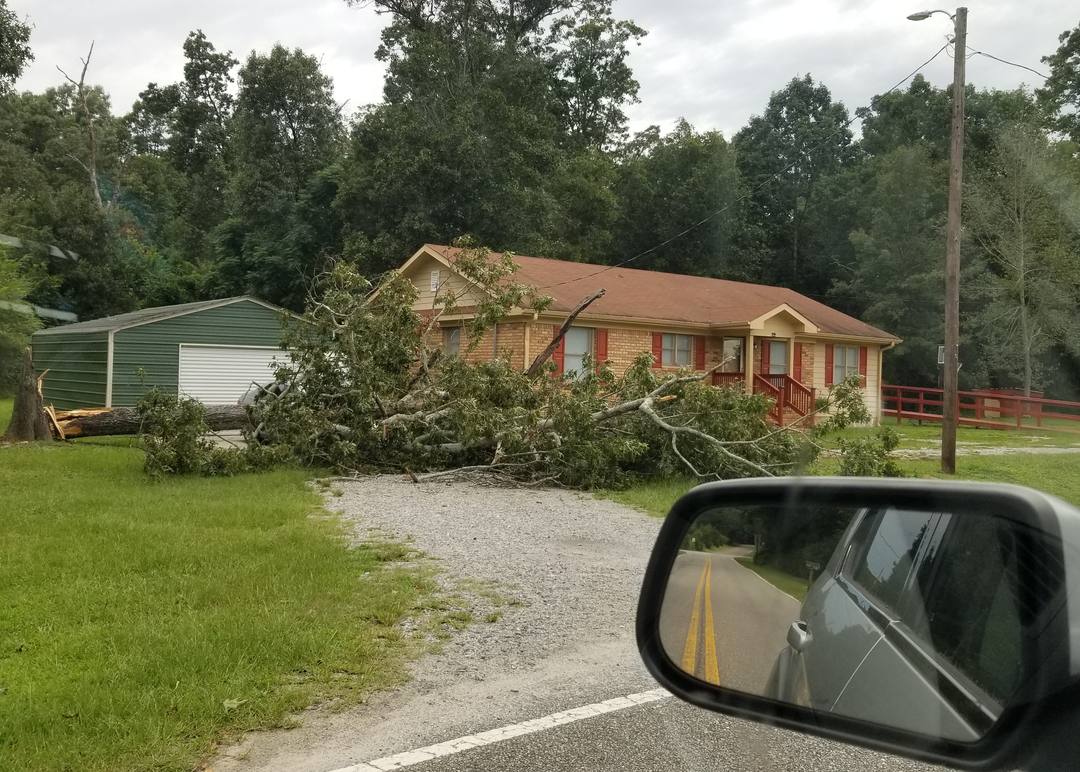
Callery pear was planted across Montgomery County subdivisions for years. It builds tight, narrow-angled branch unions with included bark, and it comes apart in wind, typically somewhere around fifteen to twenty years old. Most of the ones in Conroe are now in that window or past it.
The removal is usually simple compared to a pine — smaller, lower, and often in a front yard with room to work. The second reason to take them out is that their offspring are escaping into field edges and roadsides around the county as thorny, thicket-forming trees, which is a problem the county will be dealing with for a long while.
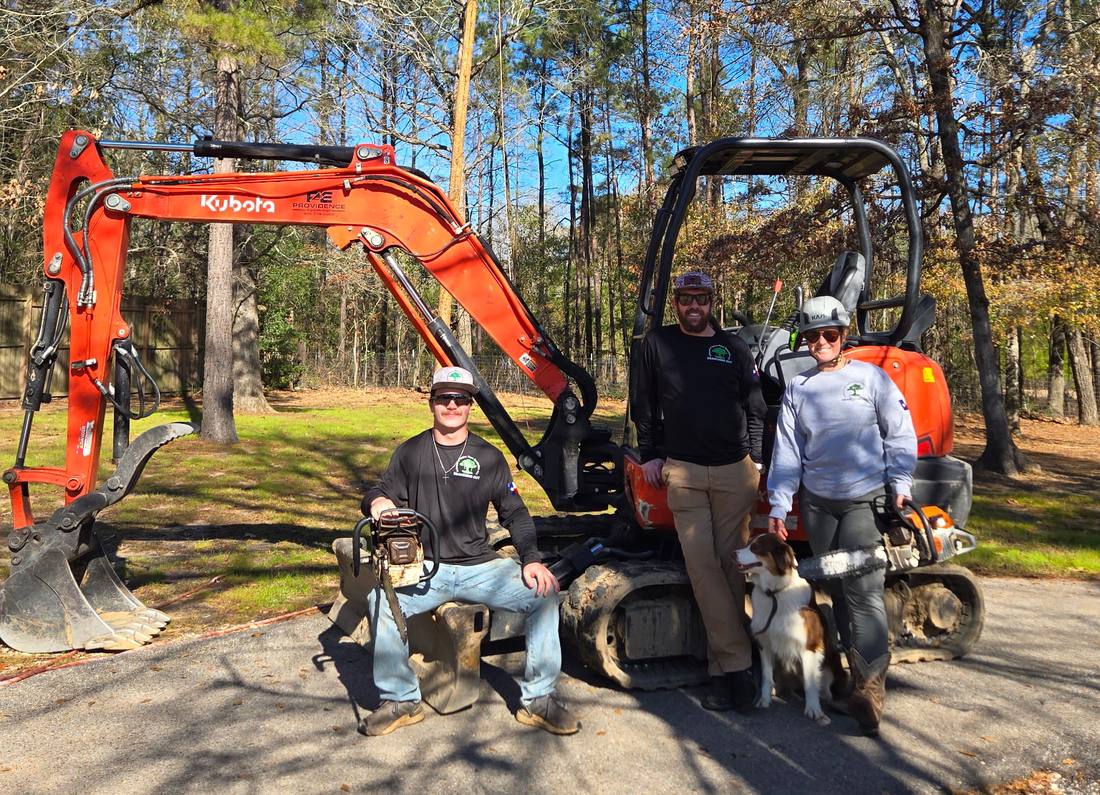
Working in a Conroe subdivision means tight side yards, close neighbors, a service drop somewhere overhead, and often a fence that has to be protected or partially removed to get equipment in. Staging is usually from the driveway, and brush travel distance matters to the price.
Then there is the paperwork. A lot of neighborhoods here carry tree provisions in their deed restrictions — approval before removal, and sometimes a required replacement planting. Check your documents before scheduling. Where a replacement is required, that is a chance to put in a species that suits the site instead of whatever the builder would have used.
Near-water properties get more wind with open water on one side and wetter ground in the low spots and coves. Banks are the thing to be careful about: the root systems on a slope are what hold it through a heavy rain, and clearing a bank for a view tends to show up as erosion the following spring. Selective removal that opens a sightline while leaving the stabilising roots in place is a better outcome than a bare slope.
Local conditions
Conroe removals are dominated by pines that were left standing through construction and are now dying three to five years later, plus the Bradford pears planted across its subdivisions.
Reviews
I can’t say enough great things about this company! They were incredibly friendly, professional, and truly a breath of fresh air to work with. They safely removed a dead tree from my property and even went above and beyond by neatly stacking the wood for me to use as firewood this year. Their prices were very fair, and the quality of their work exceeded my expectations. The Arborist (billy) helped me identify every tree on my property. If you’re looking for a reliable, honest, educated and skilled tree service, I highly recommend Branching Out Arboreal and Native Plant Specialists — you won’t be disappointed!Victoria Tillman · 8 months ago
Branching Out did an amazing job removing a dangerously dead pine tree from our backyard. The tree was right next to power lines, a transformer pole, fences, and close to our home, so it was a very difficult removal with almost no room for error. The tree was so dead it was basically crumbling while they climbed it, but their crew handled everything safely and professionally without causing any damage at all. What made the job even more difficult was that another healthy tree had actually started growing out of the dead pine, and they were able to carefully remove the pine while saving the healthy tree as well. A few weeks later, another company working nearby actually dropped a tree into power lines and took down a transformer pole — which made us even more grateful we hired Branching Out. These guys clearly know what they’re doing. Highly recommend them for any tree removal or dangerous tree work.Kenzi Standley · 2 months ago
First I want to say Branching Out is a professional company. After talking to Billy he sent me a printed quote for the work we had viewed and discussed . He removed three trees for us. His price was far more reasonable than the three other verbal quotes I had received. Also the other companies came back with lower offers after their bids were rejected. The bids were still not as low as Branching Out. The job was done super well and we enjoyed working with his whole crew, including his associate Tyler who did the stump grinding.Judy Price · a month ago
They did an excellent job cutting down a tall dead pine that was in a tight spot—no one’s favorite thing to do! Great communication, friendly, professional, and courteous. We had a challenge finding someone to service our area, so we are grateful and would highly recommend.everyotherone12 · a year ago
I was trying to save a tree and most companies want to just cut them down. But Kat & Billy went over and beyond to help me save my tree. They had to cut off alot more of the rotton branches than expected. But at least I should be able to keep this tree for were hoping another 5 yrs so I have time to get another one planted and growing before I lose this one. It's my only shade tree. They were very reasonable in thier prices and very knowledgeable. Would definitely use them again and refer them out. Thanks guysKim Taylor · a year ago
Reviews from Google · read them all
Questions
Root zone damage is not evenly distributed across a lot. One tree had the utility trench cut through its root plate and the other did not; one sat where the equipment turned around, the other stood off to the side. Depth of fill, distance from the driveway and where the pad was cut all vary tree by tree, which is why identical-looking pines on the same street fail years apart.
Sometimes, if it is caught early and the damage was partial — relieving compaction over the root zone, mulching it properly and watering through the stress period can carry a marginal tree. What does not work is starting once the crown has visibly thinned, because by then the root system has been running at a deficit for years.
If you want. On a Conroe lot that is often the point — a new-construction yard usually needs shade somewhere specific, and choosing the species and the position properly matters more than the tree itself. Clear of the foundation, out from under the service drop, off the septic field, planted in fall or winter with the root flare at grade.
Quoted per property after a look. Access drives it more than height: how close the truck can get, whether there is a gate wide enough for a chipper, how far brush has to travel, and what is underneath the tree. You get a written price before any work starts.
Get in touch
Call and talk to someone who does the work, or send the details and we'll get back to you.
Call (936) 648-2843