 Free quote
Free quote
Free quote
Tree Removal · Huntsville
Removing large, decayed and hazardous trees on tight Huntsville lots — rigging over old houses in Walker County. Call (936) 648-2843.
Tree removal in Huntsville is mostly a rigging problem. The trees over these houses were large before most of the current owners moved in, the lots in the older parts of town are not big, and there is rarely anywhere to put a seventy-foot tree on the ground in one piece. So the tree comes down in sections, lowered on ropes, with the crew working around a roof on one side and a fence on the other.
Call (936) 648-2843 to have a Huntsville tree looked at.
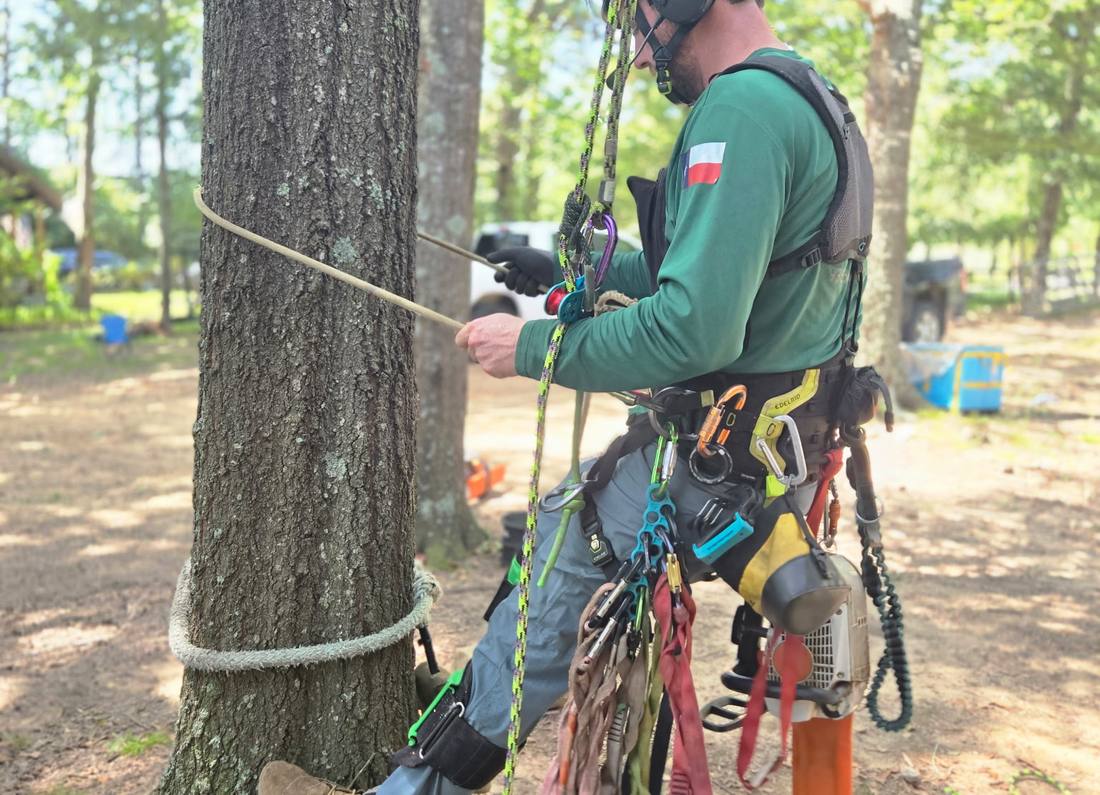
Mature water oak. This is the single most common removal in town. Water oak was planted everywhere in Huntsville because it grows fast and tolerates the heavy Walker County clay, and it reaches a stage in maturity where internal decay is close to universal. The canopy stays green while the trunk hollows out, so the first sign is usually a large limb on the lawn. Once a water oak starts shedding scaffolds over a house, the question is not whether to act.
Declining loblolly and shortleaf pine. A pine that has thinned at the top, gone dull yellow-green, or started showing pitch tubes on the trunk is a stressed tree with likely beetle activity, and pines rarely turn that around. Dead pines get harder to remove every month — they lose limbs, then bark, then the trunk integrity that lets someone climb them, at which point the same job needs a lift.
Storm leaners. A tree whose lean changed during a storm has a partially failed root plate and is under load. Cracked or heaved soil on the side away from the lean is the tell.
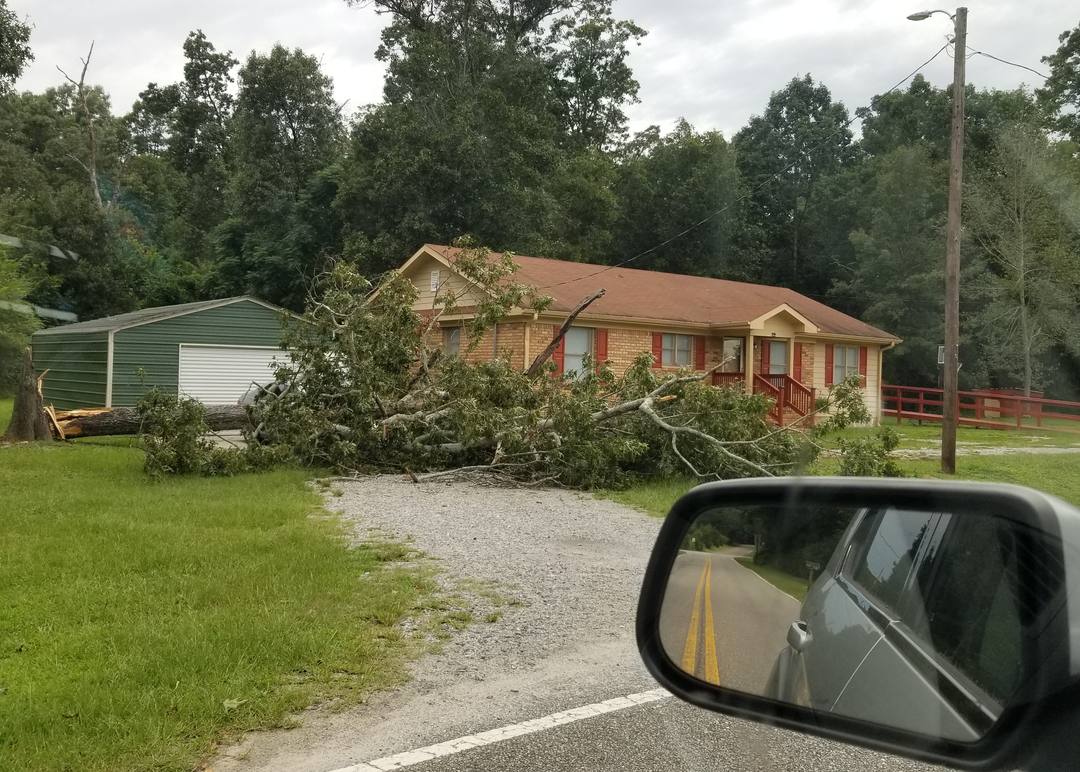
An open-pasture removal and a Huntsville back-yard removal can be the same tree and a very different job. In the older neighborhoods near the historic core and around the university, the constraints stack up: narrow side yards, detached garages, overhead service drops, fences on two or three sides, mature shrubs underneath, and a neighbor's roof close enough to matter.
Add an alley or a street too narrow to stage on and the equipment question gets harder. Access — where the truck parks, how far brush has to be carried, whether a lift can get to the back — moves the price of a Huntsville removal more than the height of the tree does.
Walker County clay is the other variable. After a wet stretch, heavy equipment on that ground leaves ruts that do not settle out. Working off mats, staging from the drive, or simply waiting a few days is often cheaper than repairing a lawn.
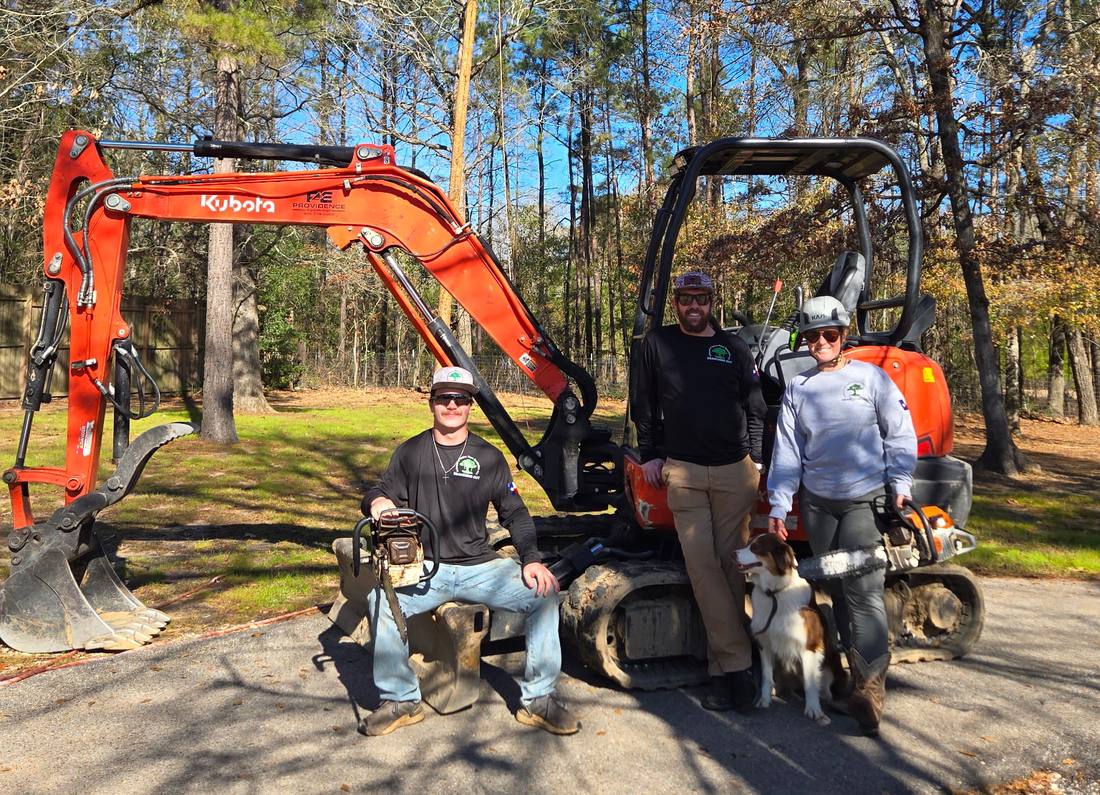
A removal in a shaded Huntsville yard changes the light dramatically, and it leaves disturbed soil. In this part of Texas that combination gets colonized — Chinese tallow, privet and chinaberry are all in the neighborhood and all faster than anything native.
Deciding what goes back into that gap is worth doing while the site is open. Sometimes it is a replacement shade tree sited better than the one that came out — away from the foundation, clear of the service drop. Sometimes the new sun is the opportunity for a pollinator bed or an edible garden in a yard that has been too shaded for either.
Local conditions
Huntsville's older neighborhoods put eighty-year-old water oaks and pines on small lots with no drop zone, so nearly every removal here is a sectional rigging job over a house.
Reviews
I can’t say enough great things about this company! They were incredibly friendly, professional, and truly a breath of fresh air to work with. They safely removed a dead tree from my property and even went above and beyond by neatly stacking the wood for me to use as firewood this year. Their prices were very fair, and the quality of their work exceeded my expectations. The Arborist (billy) helped me identify every tree on my property. If you’re looking for a reliable, honest, educated and skilled tree service, I highly recommend Branching Out Arboreal and Native Plant Specialists — you won’t be disappointed!Victoria Tillman · 8 months ago
Branching Out did an amazing job removing a dangerously dead pine tree from our backyard. The tree was right next to power lines, a transformer pole, fences, and close to our home, so it was a very difficult removal with almost no room for error. The tree was so dead it was basically crumbling while they climbed it, but their crew handled everything safely and professionally without causing any damage at all. What made the job even more difficult was that another healthy tree had actually started growing out of the dead pine, and they were able to carefully remove the pine while saving the healthy tree as well. A few weeks later, another company working nearby actually dropped a tree into power lines and took down a transformer pole — which made us even more grateful we hired Branching Out. These guys clearly know what they’re doing. Highly recommend them for any tree removal or dangerous tree work.Kenzi Standley · 2 months ago
First I want to say Branching Out is a professional company. After talking to Billy he sent me a printed quote for the work we had viewed and discussed . He removed three trees for us. His price was far more reasonable than the three other verbal quotes I had received. Also the other companies came back with lower offers after their bids were rejected. The bids were still not as low as Branching Out. The job was done super well and we enjoyed working with his whole crew, including his associate Tyler who did the stump grinding.Judy Price · a month ago
They did an excellent job cutting down a tall dead pine that was in a tight spot—no one’s favorite thing to do! Great communication, friendly, professional, and courteous. We had a challenge finding someone to service our area, so we are grateful and would highly recommend.everyotherone12 · a year ago
I was trying to save a tree and most companies want to just cut them down. But Kat & Billy went over and beyond to help me save my tree. They had to cut off alot more of the rotton branches than expected. But at least I should be able to keep this tree for were hoping another 5 yrs so I have time to get another one planted and growing before I lose this one. It's my only shade tree. They were very reasonable in thier prices and very knowledgeable. Would definitely use them again and refer them out. Thanks guysKim Taylor · a year ago
Reviews from Google · read them all
Questions
On private residential property, removal is generally the owner's decision. It gets more complicated if the tree stands in a right-of-way or a utility easement, or if your neighborhood carries tree provisions in its deed restrictions. Check with the City of Huntsville when the tree is near the street, and check your deed documents if you are in a governed subdivision.
A straightforward tree in a reachable spot is a day or less. A large decayed oak over a house on a tight lot, taken down in sections with rigging, can run longer — and that estimate depends on the same access questions that drive the price. You will get the scope and the number in writing before anything starts.
Stump grinding is quoted separately, because not everyone wants it. Left in place, a hardwood stump takes years to break down in this climate and many species will sucker around it. Wood can be cut to firewood length and left, or hauled off, and brush goes through the chipper — chips can stay as mulch, which is genuinely useful on Huntsville clay, or leave with us.
Frequently, yes. Deadwood, one failed limb or storm-torn branches are pruning work, not removal work, and a sound shade tree in an old Huntsville neighborhood is worth keeping. Removal is the answer when the trunk or root plate is compromised, when much of the canopy is already dead, or when the tree simply cannot stay where it is. We will tell you which it is before quoting a removal.
Get in touch
Call and talk to someone who does the work, or send the details and we'll get back to you.
Call (936) 648-2843